Every Char Dham guide is written for someone who can walk 16 km uphill. Two of the four shrines need almost no walking at all, and the two that do have government-rate ponies, palanquins and porter-chairs waiting at the trailhead — which means the real question for a pilgrim in their seventies is not “can I do this” but which parts of it can I buy my way out of, and which parts nobody can do for me. The answer is: you can buy the walking, almost entirely. You cannot buy the altitude.
Short answer: Gangotri and Badrinath have road to the temple gate — a few hundred metres on flat ground and a flight of steps. Yamunotri is a 5–6 km climb from Janki Chatti and Kedarnath is 16 km from Gaurikund, and both have fixed-rate pony, palki (dandi) and kandi at the base counter. Kedarnath also has a helicopter from three helipads, about ₹6,086 return from Sirsi in 2026. What no fare removes is height: the four shrines sit between 3,100 m and 3,583 m, and the risk on this circuit is altitude, not distance. So: eleven days instead of nine, Kedarnath by air or by palki rather than on foot, and an honest answer at the health screening point.
Last verified: 10 November 2026 — against the Uttarakhand registration portal’s own FAQ at registrationandtouristcare.uk.gov.in, the state health department’s Swasth, Satark, Safal Yatra advisory, the State Emergency Operations Centre’s 2026 screening and mortality figures as reported by ETV Bharat on 15 June 2026, the 2026 prepaid-counter rate cards at Gaurikund and Janki Chatti, IRCTC HeliYatra fares and baggage terms, and this site’s Kedarnath, Yamunotri and itinerary guides. Fares and counter rates are revised every season.
How much walking, dham by dham
The circuit is 1,350 km of road and 22 km of trail. Those 22 km are concentrated in exactly two places, and both of them sell a ride. Read this table before you read anything else, because it decides the whole shape of the trip.
| Dham | Walking from the last vehicle | Climb | What you can hire |
|---|---|---|---|
| Yamunotri (3,291 m) | 5–6 km from Janki Chatti (2,650 m), stone steps for most of it | About 640 m | Pony, palki, kandi, luggage porter — all at the Janki Chatti counter |
| Gangotri (3,100 m) | 100–200 m on paved flat ground from the bus and car park | Almost none | Nothing needed; the road reaches the temple |
| Kedarnath (3,583 m) | 16 km from Gaurikund (1,982 m), paved but relentlessly uphill | About 1,600 m | Pony, palki, kandi at Gaurikund; helicopter from Sirsi, Phata or Guptkashi |
| Badrinath (3,133 m) | 50–100 m from the vehicle drop, then steps into the temple compound | Under 15 m | Nothing needed; the road reaches the temple gate |
Two useful consequences follow from that table. First, a pilgrim who cannot climb at all can still complete two of the four dhams in a car, and Badrinath and Gangotri are the two that most people find the most moving anyway — Badrinath for the Tapt Kund and the Alaknanda gorge, Gangotri for the short walk to the Bhagirath Shila. Second, the “Char Dham for seniors” question is really a Kedarnath question, because Kedarnath is the only place where the choice of how you arrive decides how the trip feels.
The Kedarnath climb, stage by stage
The trail from Gaurikund gains 1,600 m over 16 km on a made path. It is hard on the lungs before it is hard on the legs, and the last 5–7 km above Lincholi is where people who were fine at Bheembali start to struggle. Break it into the four stages the trail actually has, and a senior pace stops being a guess.
| Stage | Distance | Fit adult | Plan for at 70 | What is there |
|---|---|---|---|---|
| Gaurikund → Jungle Chatti | 4 km | 1.5–2 hrs | 2.5–3 hrs | Steady climb, tea stalls, first rest point |
| Jungle Chatti → Bheembali | 3 km | 1–1.5 hrs | 1.5–2 hrs | Forest section, the gentlest gradient of the four |
| Bheembali → Lincholi | 3–4 km | 1.5–2 hrs | 2–2.5 hrs | Open valley, fully exposed to rain and wind, medical post |
| Lincholi → Kedarnath | 5–7 km | 2.5–3.5 hrs | 3.5–4.5 hrs | The long final push; temple appears in the last hour |
Total it: 9 to 12 hours on foot at a senior pace, which is a full day and then some. That single number is the argument for a pony or a palki, and it is also the argument against trying to walk up and ride down — the descent is harder on the knees than the climb, and on a mule it takes 2.5 to 3 hours against 5 to 6 on foot. Kedarnath’s own temple committee and the district administration both push the same advice: one darshan a day, start at first light, and do not attempt the trail on the day you drove in from Rishikesh.
Pony, palki, kandi: what you are actually buying
Three different services, three different experiences, and one rule that protects you: everything is booked at the prepaid government counter at the trailhead, at a printed rate, and you get a slip. Mule rates are fixed by the District Magistrate, dandi and kandi rates by the Zila Panchayat — and anyone who approaches you on the path with a “special rate” is quoting 30 to 50 per cent above the board. Pay the counter, keep the slip, and quote it if challenged.
| Dham | Service | 2026 counter rate | Journey time | Weight and conditions |
|---|---|---|---|---|
| Kedarnath | Mule / pony, up | ₹3,200 | 3–4 hrs | One rider per animal; no side-saddle for two |
| Kedarnath | Mule / pony, down | ₹2,300 | 2.5–3 hrs | Same-day return about ₹5,500 |
| Kedarnath | Dandi / palki, four carriers | ₹9,200 up to 60 kg | 5–7 hrs | Weight slabs run to 120 kg (₹15,200); down is ₹8,200 |
| Kedarnath | Kandi, porter chair | ₹6,000 up to 25 kg, ₹8,000 up to 50 kg | 6–7 hrs | Single passenger, one or two porters, no luggage |
| Kedarnath | Pitthu, luggage only | ₹1,000–1,500 a bag | Depends on the load | No printed card — agree the bag rate first |
| Yamunotri | Mule / pony, round trip | ₹3,500 plus ₹150 counter fee | 2–3 hrs up | Up to 80 kg; with night halt ₹3,750 |
| Yamunotri | Kandi / porter chair | ₹1,800 round trip, ₹2,700 for 40–60 kg | 3–4 hrs | Up to 40 kg in the base slab |
| Yamunotri | Palki / doli | ₹7,000 round trip plus ₹600 counter fee | 4–5 hrs | Carried, 50 kg and above; with night halt ₹8,000 |
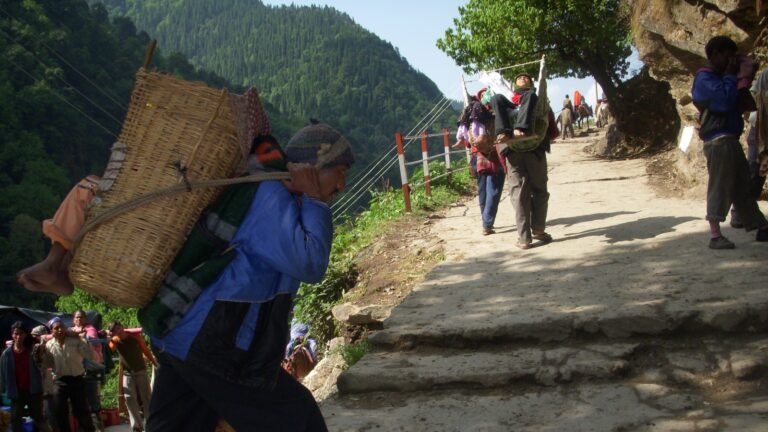
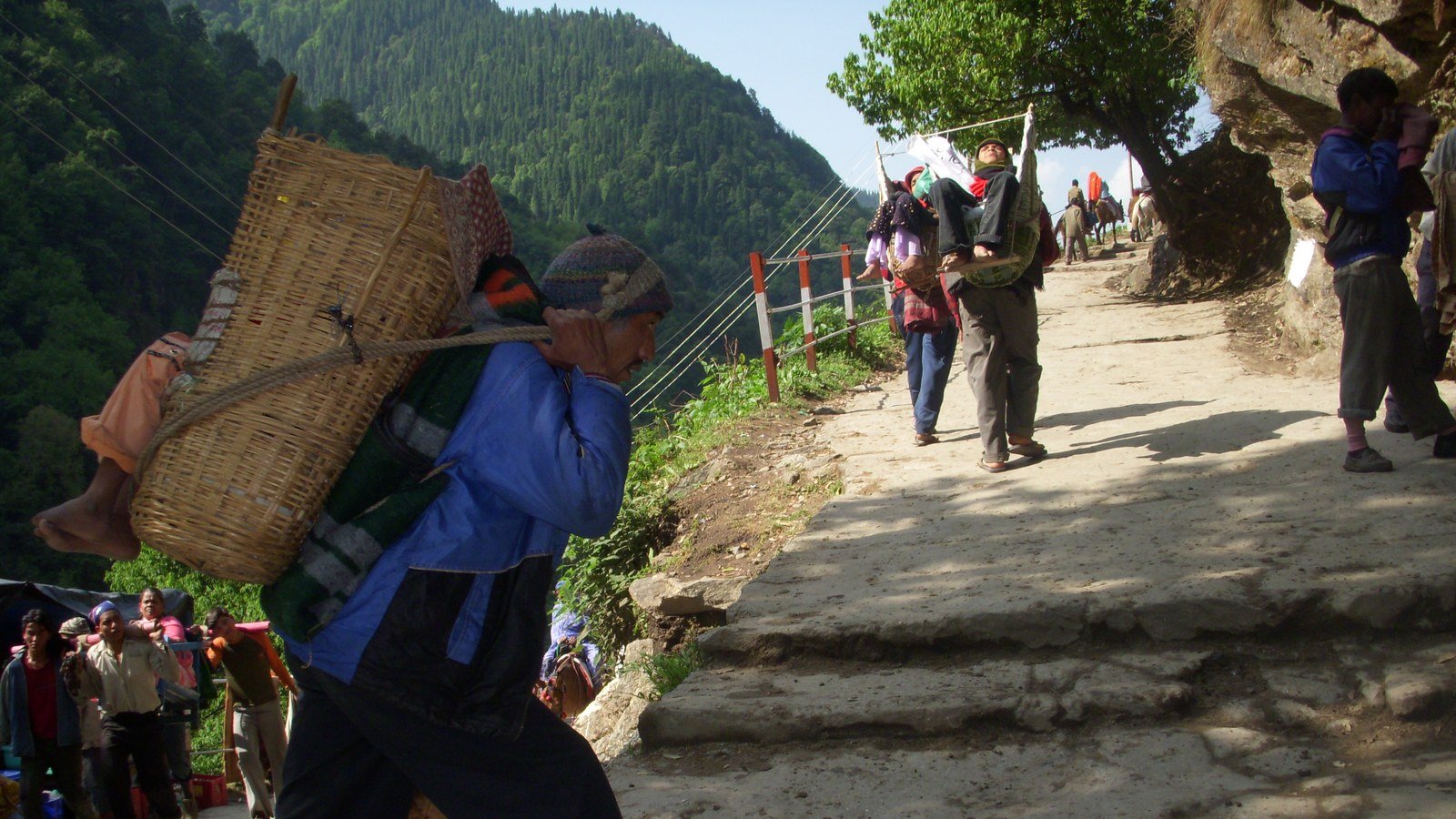
The choice between them is about the body, not the budget. A pony is the fastest and the cheapest, and it is the wrong choice for anyone with back pain, a hip replacement, uncontrolled blood pressure or a fear of heights — the trail’s edge sections are narrow and the animals know their own way but not your spine. A dandi is a canvas chair on two poles carried by four men who walk in step; it is slow, it is expensive, and it is the only option that lets a pilgrim who cannot sit astride anything still reach the temple. A kandi sits between the two. All three sell out: at Gaurikund in May and June, be at the counter by 4:00–5:00 AM, because the numbers for the day are gone by mid-morning.
The helicopter: what it fixes, and what it does not
A helicopter from Sirsi, Phata or Guptkashi removes the 16 km in about ten minutes each way. It does not remove the 3,583 m. Pilgrims who fly up still stand in the same queue at the same altitude, and the ones who feel unwell on arrival are the ones who came up from 200 m that morning with no acclimatisation at all. If you are flying, spend the previous night at Guptkashi (1,319 m) rather than Rishikesh (372 m).
| Helipad | Round-trip fare (2026) | In the air | What it solves |
|---|---|---|---|
| Sirsi | About ₹6,086 | About 10 min each way | The whole trek, for the lowest fare of the three |
| Phata | About ₹9,680 | About 10 min each way | The trek, from the helipad most operators use |
| Guptkashi | About ₹12,154 | About 15 min each way | The trek, from the town where you are probably sleeping |
Add the IRCTC convenience fee and GST on top, book only on heliyatra.irctc.co.in, and expect to be weighed at the helipad: 80 kg is free, excess is ₹150 a kilo per person and cannot be averaged across a family. A soft bag of 5 kg is the allowance, so the main luggage stays in the hotel. You cannot buy a ticket without a Char Dham registration number or Group ID.
One warning that matters more for 2027 than for any other part of this page. The full four-dham charter — the Dehradun–Sahastradhara circuit that lands at all four shrines in a day or two — collapsed at the end of the 2026 season: after the Directorate General of Civil Aviation made two pilots mandatory per aircraft, the operators cancelled every remaining trip from 2 November and said they would not resume until the rule is resolved. The short Kedarnath shuttles from Sirsi, Phata and Guptkashi kept flying. So for 2027, treat the Kedarnath hop as bookable and treat any “four dham by helicopter in two days” package as a promise that depends on a regulatory decision nobody has made yet.
Four route shapes, and the one to take
The mistake almost every senior group makes is booking the standard nine-day circuit and hoping. The nine-day plan contains a 12-hour day (Barkot to Yamunotri and on to Uttarkashi) and a 10-hour drive to Badrinath, and those two days are what breaks people — not the trek. Here are the four honest shapes.
| Shape | Days from Haridwar | Total walking | Nights above 3,000 m | Best for |
|---|---|---|---|---|
| Standard road circuit, 9 days | 9 | 22 km | 1 (Kedarnath) | Fit pilgrims under 60 who can walk 16 km in a day |
| Road circuit with pony and palki, 11 days | 11 | 2–4 km | 2 (Harsil, Kedarnath) | Most pilgrims over 65 — no 12-hour day, no long climb |
| Road circuit with the Kedarnath helicopter | 9–10 | Under 2 km | 0 | Anyone with a heart, lung or knee condition; fly up, sleep low |
| Drive-in only: Gangotri and Badrinath | 5 | Under 1 km | 0 (Badrinath is a 3,133 m night, Harsil 2,620 m) | Pilgrims who should not be above 3,200 m at all |
The 11-day version is the one to take, and it is not padding: it removes the 12-hour day, puts a night at Harsil (2,620 m) before Kedarnath, and gives Badrinath a morning instead of an aarti and a rushed departure. The day-by-day itinerary has the 11-day table in full. If the group cannot manage even that, the drive-in shape is a real yatra and not a consolation prize — Gangotri and Badrinath are two of the four, and both are reached by road.
The day-length problem is the real enemy
The state’s own advisory asks for a yatra of at least seven days, rest of 5–10 minutes for every hour of trekking and every two hours of driving, and no more than 800–1,000 m of elevation gain in a day. Compare that with the standard circuit’s days and you can see where the plan and the advisory disagree. The fix is arithmetic: add 20 to 30 per cent to every drive time and put a real lunch stop in each long leg.
| Leg | Distance | Normal time | Plan for at 70 | Where to break it |
|---|---|---|---|---|
| Haridwar → Barkot | 190 km | 7–8 hrs | 8–9 hrs | Chamba for lunch; tea at Dharasu |
| Barkot → Janki Chatti | 45 km | 1.5 hrs | 2 hrs | Sayana Chatti, for the view and the loo |
| Barkot → Uttarkashi | 123 km | 4–5 hrs | 5–6 hrs | Dharasu bend, where the two valleys meet |
| Uttarkashi → Gangotri | 100 km | 3.5–4 hrs | 4–5 hrs | Bhatwari, then Harsil on the way back |
| Uttarkashi → Guptkashi | About 250 km | 8–9 hrs | 10 hrs | Tehri for lunch, Rudraprayag for tea |
| Guptkashi → Sonprayag | 35 km | 1–1.5 hrs | 1.5–2 hrs | Nowhere — start at 5:00 AM, the jeep queue is the delay |
| Guptkashi → Badrinath | About 230 km | 9–10 hrs | 10–11 hrs | Karnaprayag, then Joshimath; a night at Joshimath is better than a push |
| Badrinath → Rudraprayag | About 160 km | 7–8 hrs | 8 hrs | Joshimath for breakfast, Karnaprayag for lunch |
One hard rule on top of the timings: vehicle movement on the Char Dham routes is barred between 10 PM and 4 AM, and the checkposts enforce it. It is a road-safety rule aimed at exactly the kind of day that ends with a tired driver on a hill road after dark, and it is why every plan on this site starts at 5:00–6:00 AM. For a group over 65, treat 6 PM as your own cutoff and let the buffer absorb the landslides.
What the state’s screening points actually do
Uttarakhand screens pilgrims at seven checkpoints — Rudraprayag, Chamoli, Gangotri, Yamunotri, Haridwar, Pauri and Dehradun — and the check is free. Blood pressure, pulse and oxygen saturation, with a doctor or paramedic at each post. The 2026 season’s own numbers show both how seriously the state takes it and how many people ignore what it tells them.
| Measure | 2026 figure | What it means for you |
|---|---|---|
| Pilgrims screened to 11 June 2026 | 6,42,321 | Screening is routine, not an accusation; expect it and allow 20 minutes |
| Found to have a comorbidity | 23,657 | Most continued the yatra — the flag is a warning, not a ban |
| Flagged high-risk | 2,697 | Of those, only 170 went home; the rest proceeded against advice |
| Deaths in the first 56 days | 190 — 91 on the Kedarnath route | Kedarnath is where the altitude and the effort meet; that is where to spend your money |
| Medical cover on the routes | 177 ambulances, 1,350+ doctors and paramedics, an AIIMS Rishikesh helicopter ambulance | Help is close on the main trails; it is thin on the drivable passes after dark |
Read the third row twice. Two thousand six hundred and ninety-seven pilgrims were told they were high-risk and 170 turned back. That is the single most useful fact on this page for a family planning the trip: the system will warn you, and the warning is worth more than the fare you already paid. If a doctor at Sonprayag says do not go up, the correct decision is to take the helicopter down to Guptkashi and do darshan at Ukhimath instead, where the idol of Kedarnath spends the winter.
Paperwork: the e-pass, the fitness certificate, the age question
Registration is compulsory for every pilgrim, free, and done at registrationandtouristcare.uk.gov.in or on the Tourist Care Uttarakhand app. It is checked with a biometric scan at Sonprayag for Kedarnath and at Janki Chatti for Yamunotri, and an unregistered pilgrim is turned back. The registration guide walks through it screen by screen.
| Document | Why it matters for a senior | Where it is checked |
|---|---|---|
| Yatra e-pass (printed) | Entry to every dham; the phone copy fails where the network does | Sonprayag, Janki Chatti, temple gates |
| Fitness certificate from an MBBS doctor | Not demanded of every pilgrim, but it is what settles a question at a checkpost — carry it | Health screening points, helipads, some hotels |
| Prescription list with generic names | A chemist in Uttarkashi stocks the molecule, not your brand | Any pharmacy or relief post |
| Travel insurance that covers helicopter evacuation | Air ambulance and heli-evac are billed, and most policies exclude altitude above 3,000 m | Nowhere — which is why it catches people out |
On age, be careful with what you read. The official portal’s own FAQ still answers “Is there any age-limit for registration?” with “Yes, people aged (10-65years) can do registration for the Char Dham Yatra.” That line is the most misleading sentence on the portal for a 70-year-old: pilgrims well past 65 travel every season, the health department screens everyone over 50 as a matter of routine, and in 2026 it screened 2,52,843 pilgrims above 50. What a senior actually needs is not a permission slip but a fitness certificate, a slower plan, and the judgement to stop.
Medicines, oxygen and the oximeter
The advisory’s thresholds are specific, and they are the ones to pack against. Oxygen saturation below 90 per cent is the line at which you stop and find a medical relief post — not the line at which you take another puff of canned oxygen and carry on. Cans are sold along the trail and at Gaurikund, and they are useful for the ten minutes of breathlessness after a steep section; they are not acclimatisation and they do not fix altitude sickness. A ₹1,500 pulse oximeter in your pocket is a better purchase than three cans.
Carry the regular medicines in the original strips with a copy of the prescription, plus paracetamol, an antiemetic for the drive, ORS sachets, and a knee support if the descent is on the plan. The advisory asks for two litres of fluid a day and forbids alcohol and sleeping pills on the route — the second matters more than it sounds, because sedatives depress breathing at altitude and are the reason some pilgrims do not wake up at Kedarnath. If you cannot sleep at 3,583 m without a pill, that is your body telling you not to sleep at 3,583 m.
Five things to skip
Every one of these is a decision that costs a day or a night and buys nothing.
- The night at Kedarnath if you have any cardiac or respiratory history. Fly up after a night at Guptkashi, do darshan, fly down. The heli shuttle is built for exactly this, and the 2026 death figures are concentrated on that route.
- The hot springs. Tapt Kund at Badrinath and Surya Kund at Yamunotri are near-boiling water at 3,100 m. A plunge is a sudden cardiovascular load; most senior groups are better off with a warm bucket in the hotel.
- The 4:00 AM darshan queue. It is the coldest hour of the day and the longest stand. The 6:00–8:00 AM slot is warmer, shorter, and the same darshan.
- Mana village and the last-km walks on days that already have a 10-hour drive. They are worth doing on a day with nothing else in it.
- Any “guaranteed darshan” package. There is no VIP line for sale at these four temples, and the state has repeatedly said so.
Where to go next
If the shape is decided, the next questions are the date, the money and the individual shrines. The 2027 hub tracks opening and closing dates, the month-by-month guide says which weeks are kind to older bodies and which are not, the cost guide prices the circuit, and the packing list covers the bag. For the two shrines that need no walking, start with Gangotri and Badrinath; for the two that do, read the Kedarnath and Yamunotri guides before you book a single fare.
Frequently asked questions
Is there an age limit for the Char Dham Yatra?
No hard limit is enforced at the temples, but the official registration portal’s FAQ still prints an age band of 10 to 65 years. Pilgrims well past 65 travel every season, and the health department screens every pilgrim over 50 at seven checkpoints. Carry a fitness certificate from an MBBS doctor and plan for altitude rather than distance.
Can a 70-year-old do the Char Dham Yatra without trekking?
Yes. Gangotri and Badrinath have road to the temple gate, so those two need only a few hundred metres of walking. Kedarnath can be done by helicopter from Sirsi, Phata or Guptkashi, and Yamunotri by pony, palki or kandi from Janki Chatti. The circuit then involves under 4 km of walking in total.
How much does a palki cost at Kedarnath?
₹9,200 one way from Gaurikund to Kedarnath for a passenger up to 60 kg on the 2026 counter card, rising by weight slab to ₹15,200 at 120 kg; the descent is ₹8,200. It is booked at the prepaid counter at the Gaurikund mule stand, not online, and the printed slip is your protection against overcharging.
Is the helicopter safe for elderly pilgrims?
The flight is short and the operators fly it all season, but it does not acclimatise anyone — you land at 3,583 m from a base at 1,300 m. Spend the previous night at Guptkashi or Phata, not Rishikesh, and tell the operator about any cardiac condition at booking.
How many days should a senior allow for Char Dham?
Eleven days from Haridwar, with no leg longer than eight hours of driving and a night at Harsil before Kedarnath. The standard nine-day circuit contains a 12-hour trek-and-drive day and a 10-hour drive to Badrinath, and those two days are what exhaust older groups.
What happens if I am flagged at the health screening point?
You are examined by a doctor at the post, usually for high blood pressure or an oxygen saturation below 90 per cent. In 2026, 2,697 pilgrims were flagged high-risk and only 170 turned back. If you are advised not to ascend, take the advice — darshan at Ukhimath, the winter seat of Kedarnath, is the alternative.
Do I need oxygen cylinders for the Char Dham Yatra?
No, and they are not a substitute for acclimatisation. Cans are sold along the trail and at Gaurikund, and medical relief posts carry oxygen. A portable pulse oximeter is the more useful purchase: the state advisory’s threshold is a saturation below 90 per cent, at which point you descend and find a post.
Is the road to Gangotri and Badrinath good enough for a senior?
Yes — both are drive-in shrines with parking close to the temple. The drives are long, not rough: Uttarkashi to Gangotri is 100 km in three and a half to four hours, and Joshimath to Badrinath is about 45 km in an hour and a half. Add 20 to 30 per cent to every hill time.
Can a senior travel alone on the Char Dham circuit?
Not advisable. The circuit involves shared jeeps, queues and a 16 km trail with patchy phone coverage, and the registration form requires an emergency contact who is not travelling with you. Travel with one companion at minimum, and put both e-passes in both bags.
When is the best month for older pilgrims?
Mid-May to mid-June and September to early October: the road is clear, the days are long, and the temperature at 3,100 m stays above freezing at night. July and August bring landslide closures and wet trail surfaces, and the last week of the season brings early snow to Kedarnath.
Counter rates, helicopter fares and screening figures are the 2026 season’s, verified on 10 November 2026. Pony, palki and helicopter rates are revised every season and 2027 fares are not yet published — read the printed slip at the counter and the IRCTC portal before paying. Altitude does not change with money, so treat the health advisory as the one part of this plan that is not negotiable.
Header photo: a porter carries a pilgrim up the Kedarnath trail in a kandi basket, with palkis ahead on the path. Image via Wikimedia Commons, CC BY-SA 3.0. Counter rates, helicopter fares and screening figures are the 2026 season’s, verified on 10 November 2026.