
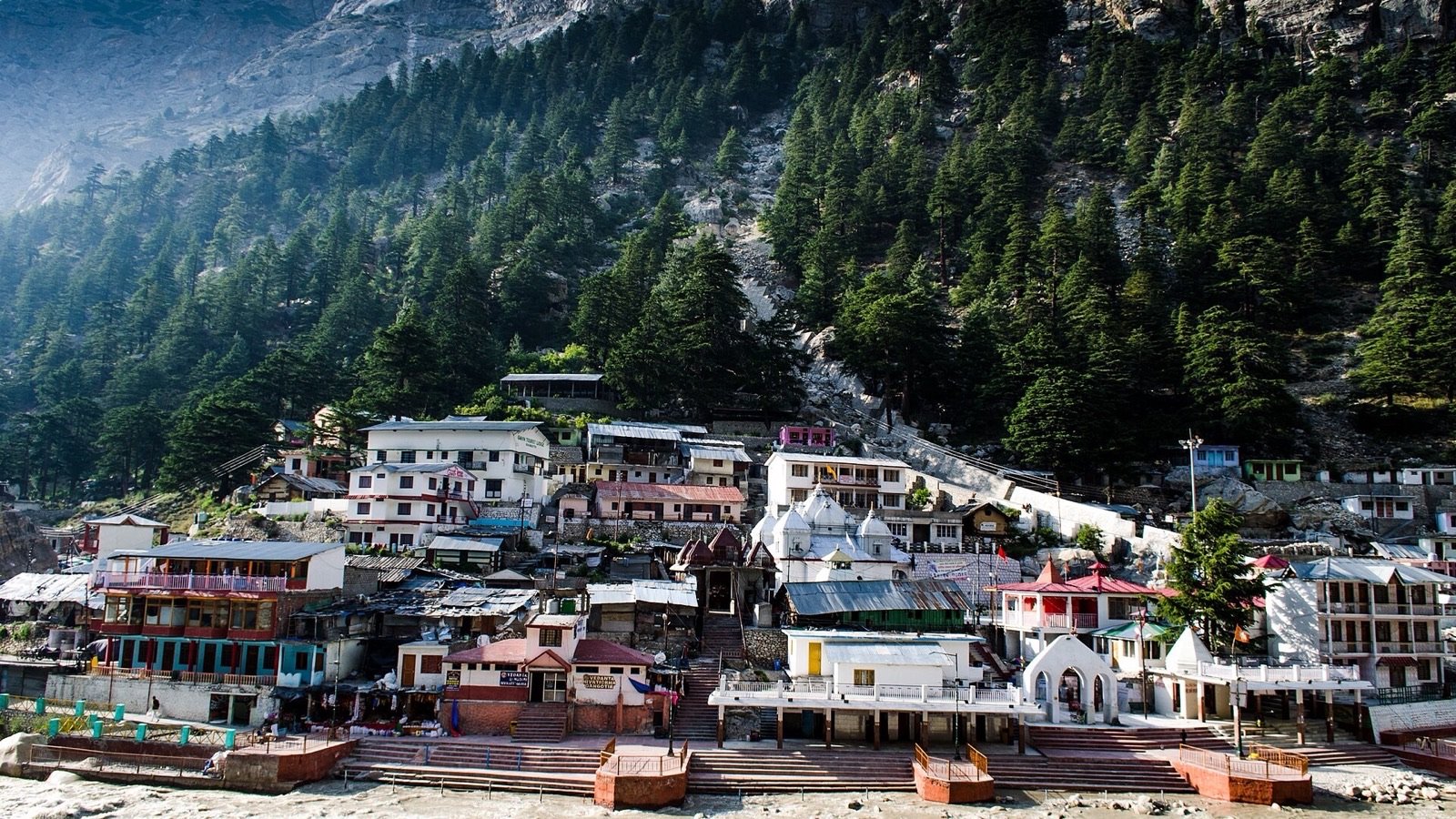
Gangotri is the first dham to open every year and the one most people plan worst. It sits at 3,100 m on the right bank of the Bhagirathi, 18 km downstream of the glacier mouth at Gaumukh, and on every Char Dham itinerary it gets treated as a stop between Uttarkashi and Harsil instead of a destination. That is a mistake: the temple, the ghats, the aarti and the two short walks around it need a night, not two hours.
This guide covers what is actually known about the 2027 season and what is not. The opening date for Gangotri is a panchang calculation, not an announcement, so it can be stated a year ahead — but the darshan hours, the rules at the gate and the road conditions are not, and they changed materially in 2026.
Quick answer: Gangotri temple opened on 19 April 2026 at 12:15 PM and closed on 10 November 2026. The 2027 doors open on Akshaya Tritiya, 9 May 2027, with the muhurat confirmed in April, and the season ends around Diwali in late October or early November. Registration is free and compulsory and is checked at the temple gate, and the road reaches Gangotri town — the temple is a five-minute walk from the bus stand, with no trek.
Last verified: 28 October 2026, against the Uttarakhand Char Dham registration portal, the Devasthanam board’s Gangotri pages, the Gangotri Temple Committee’s 2026 timing decisions, and the 2026 opening and closing announcements.
यह गाइड हिंदी में भी उपलब्ध है: गंगोत्री यात्रा 2027 — पूरी हिंदी गाइड.
Gangotri Yatra 2027 at a glance
| Altitude | 3,100 m / 10,170 ft — on the Bhagirathi, below the Gangotri glacier |
| District | Uttarkashi, Garhwal Himalaya, Uttarakhand |
| Deity | Ganga, worshipped here as Bhagirathi — the river is called Bhagirathi until Devprayag, where it becomes the Ganga |
| Road access | Motorable to Gangotri town. No trek to the temple — a five-minute walk from the bus stand, with steps at the gate. |
| 2026 season | Opened 19 April 2026 at 12:15 PM · Closed 10 November 2026 at 12:05 PM |
| 2027 season | Doors open on Akshaya Tritiya, 9 May 2027 (muhurat to be confirmed in April) |
| Registration | Compulsory and free — registrationandtouristcare.uk.gov.in |
| Distance from Rishikesh | ~270 km by road, 9–10 hours |
| Darshan hours (2026 schedule) | 6:00 AM–4:00 PM, then 7:45 PM–10:00 PM after the evening aarti |
| Winter seat | Mukhba, near Harsil — the idol moves there when the temple closes |
| Helplines | 1364 (tourist) · 1077 (state disaster) · 108 (ambulance) |
When does Gangotri temple open and close?
Gangotri and Yamunotri open on Akshaya Tritiya, the third day of the bright half of Vaishakha. That is a calendar event, so unlike Kedarnath and Badrinath — whose dates are announced at Mahashivratri and Basant Panchami — the Gangotri date can be worked out years ahead. What the Gangotri Temple Committee fixes at its annual meeting in March or April is the muhurat, the hour on that day when the doors open, along with the season’s darshan timetable.
In 2026 the doors opened at 12:15 PM on 19 April, on Akshaya Tritiya, and the season began with Gangotri and Yamunotri together. Akshaya Tritiya falls on 9 May 2027 — three weeks later than 2026, because the Hindu year carries an extra lunar month — so 9 May 2027 is the working date. Treat it as firm until the committee meets; a shift of a day is possible, a shift of more than that is rare.
| Season | Opens | Closes | Notes |
|---|---|---|---|
| 2026 (actual) | 19 April, 12:15 PM | 10 November, 12:05 PM | 9.4 lakh pilgrims visited Gangotri during the season |
| 2027 (expected) | 9 May — Akshaya Tritiya | Late October, around Diwali (29 October 2027) | Muhurat and darshan hours announced in April |
Why the closing date is the fuzzier one
Gangotri shuts for the winter on the Diwali–Annakut sequence, and the committee picks the exact day from the panchang each autumn. In 2026 that landed on 10 November at 12:05 PM, with the idol carried down to Mukhba village near Harsil the same week. For 2027, with Diwali on 29 October, plan on the last days of October or the first days of November, and do not book a late-October darshan without confirming the closure notice in September.
Do you need registration for Gangotri?
Char Dham registration has been compulsory since 2014 and is still free. It is one form for all four dhams, and it is the single document that most often stops people at Gangotri — not because it costs anything, but because the check happens at the temple gate, not at Rishikesh, and there is no useful mobile signal on the last 100 km to fix it on the spot.
What you need
- A government photo ID for every traveller — Aadhaar, passport, driving licence or voter ID. Children need a school ID or a birth certificate.
- A mobile number that receives SMS, and an email address if you want the pass by mail.
- Your travel dates and, if you are driving, the vehicle number.
- For foreigners, passport number and visa details — the portal accepts them, and the counter staff will want to see the passport itself.
What you get
A QR-coded e-pass by SMS and email. Registration for the 2026 season opened on 6 March; expect the 2027 window to open in early March as well. Print two copies. Signal dies beyond Uttarkashi, and a screenshot is worth nothing if your battery goes.
Where the check actually happens
Verification counters sit at the entry gate of each of the four dhams — Gangotri included — and the police check passes on the highway use the same pass. Gangotri’s counter is at the temple approach, a few metres before the queue barrier. If you are on a package, the operator registers the group, but each pilgrim still needs their own entry on the pass.
If you are driving
Private and hired vehicles also need a Green Card and trip card, generated at greencard.uk.gov.in. It is free, takes ten minutes, and is checked on the Char Dham route. Carry the printed card in the windscreen along with the passenger pass.
How do you reach Gangotri?
One road: NH-34 from Rishikesh through Chamba, Dharasu and Uttarkashi, then 100 km up the Bhagirathi valley. That is about 270 km and 9–10 hours from Rishikesh, and there is no airport or railway anywhere near it.
One road, NH-34, from Rishikesh through Chamba, Dharasu and Uttarkashi, then 100 km of hill road up the Bhagirathi valley to the temple. There is no airport and no railway anywhere near it.
| Starting from | Road distance | Driving time |
|---|---|---|
| Rishikesh | ~270 km | 9–10 hours |
| Haridwar | ~290 km | 9.5–10.5 hours |
| Dehradun | ~250 km | 9–10 hours |
| Delhi | ~500 km | 13–15 hours |
| Uttarkashi | 100 km | 3.5–4.5 hours |
| Harsil | 25 km | 1 hour |
| Yamunotri (Janki Chatti) | ~220 km | 8–9 hours |
The Uttarkashi–Gangotri stretch is the part to plan around
This is 100 km that takes four hours on a good day. The road climbs out of Uttarkashi past Bhatwari and Sukhi, crosses into the deodar belt above Dharali, runs through Harsil, then squeezes along the gorge past Lanka and Bhairon Ghati to Gangotri. Two things matter: it is the most slide-prone stretch on the route, and it is one-lane in places where trucks and taxis have to negotiate. Leave Uttarkashi by 7 AM An afternoon departure means arriving in the dark on a road with unlit edges.
By train
The nearest useful stations are Rishikesh (on the narrow-gauge line from Haridwar), Haridwar and Dehradun. Rishikesh is the closest and has the most onward transport; Haridwar has the better long-distance connections. From any of them it is a road journey of nine hours or more, so most people arrive the night before and start at dawn.
By air
Jolly Grant (Dehradun) is the only airport in the region — about 35 km from Rishikesh and 250 km from Gangotri. There is no scheduled helicopter service to Gangotri, and no airstrip closer than Dehradun.
Bus and taxi
UTC ordinary buses run Rishikesh–Uttarkashi and Uttarkashi–Gangotri as separate legs; the two together come to roughly ₹550–800 and take ten hours with the change. Direct private seater services are listed at about ₹1,000 one way. Shared jeeps are faster, leave when full, and still require the Uttarkashi change. A private cab from Rishikesh is the only way to do it in a single comfortable run: roughly ₹6,000–10,000 per vehicle one way depending on the car, and ₹14,000–20,000 for a three-day round trip with driver wait included.
What are the Gangotri darshan timings?
Darshan runs 6:00 AM–4:00 PM, the doors shut from 4:00 PM to 7:45 PM, the ghat aarti is at about 7:00 PM, the temple aarti at 7:45 PM, and evening darshan continues to 10:00 PM. These are the 2026 hours, and the committee re-sets them each April along with the muhurat.
Gangotri’s darshan timetable changed in 2026, and the change is not cosmetic: the temple used to shut at 2 PM and reopen at 3 PM, which pushed everyone onto the road at the worst time of day. The committee closed that gap and extended the evening instead.
| Window | Hours (2026 schedule) | What happens |
|---|---|---|
| Morning darshan | 6:00 AM–4:00 PM | Continuous darshan; the queue is heaviest 9:00 AM–12:00 PM |
| Temple closed | 4:00 PM–7:45 PM | Doors shut for the afternoon; pilgrims move to the ghats |
| Ganga aarti at the ghat | ~7:00 PM | Open-air aarti on the Bhagirathi steps, no queue, no ticket |
| Temple aarti | 7:45 PM | Doors reopen for the evening aarti |
| Evening darshan | 7:45 PM–10:00 PM | Darshan continues after the aarti until shayan |
| Shayan | 10:00 PM | Temple closes for the night |
Check these hours again in April 2027 — the committee sets them at the same meeting that fixes the muhurat, and 2026’s version was a deliberate break with the old 6 AM–2 PM / 3 PM–9:30 PM pattern.
The ghat aarti is the part people miss
Everyone queues for the 7:45 PM temple aarti and ignores the 7 PM aarti on the ghats, which is the better experience: the Bhagirathi in spate, the bells from three directions, and fifty people instead of five hundred. Stand on the steps below the temple, on the right bank, and then walk up for the temple aarti when it starts. Doing both in one evening is the reason to sleep in Gangotri rather than Harsil.
Phones and cameras
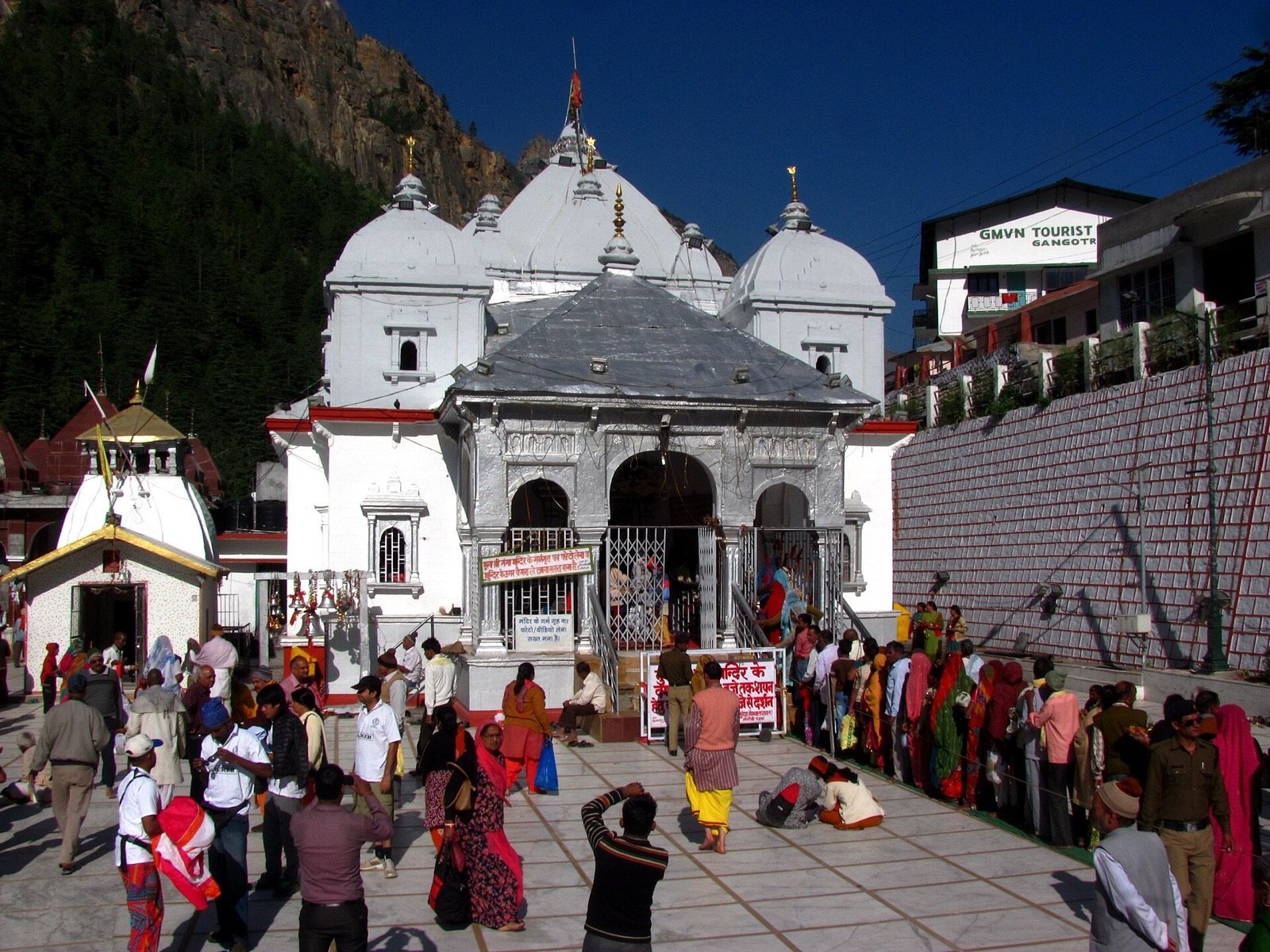
Mobile phones are banned inside the temple premises, and in 2026 the committee extended the ban to priests, staff and anyone filming — live-streaming darshan from inside is explicitly not allowed. Leave the phone at the hotel or in the vehicle. Cameras are tolerated in the courtyard and on the ghats, not in the sanctum.
Booking a puja
There is no official online puja counter for Gangotri. The Devasthanam board’s online booking covers Badrinath and Kedarnath only, and the packages advertised at ₹2,100–2,500 for a “Gangotri puja” are resellers buying on your behalf. At the temple, pujas — Ganga puja, rudrabhishek, aarti sankalp — are arranged through the tirth purohits who sit by the gate and the committee issues a receipt. Ask for the receipt; it is your only protection against the invented price.
Is there a helicopter to Gangotri?
Nothing scheduled, and no landing at the temple. The IRCTC HeliYatra portal sells Kedarnath and Hemkund Sahib only; what exists is a Dehradun–Harsil charter at about ₹3.75–4 lakh per helicopter for four to six seats, and it lands 25 km short, so you still drive the last hour.
Nothing scheduled, and no landing at the temple. The IRCTC HeliYatra portal sells Kedarnath and Hemkund Sahib only, so any site advertising an “official Gangotri helicopter ticket” is reselling a charter seat.
What exists is a Dehradun–Harsil charter, usually bundled into a Char Dham helicopter package. The helicopter lands at the Harsil helipad, 25 km and about an hour short of Gangotri, and you cover the last stretch by road. Charter rates run about ₹3.75–4 lakh per helicopter for four to six seats; the Char Dham packages that include Gangotri and Yamunotri sell seats at ₹2.2–2.45 lakh per person and assume you can fly when the weather allows, which in the Bhagirathi valley in May and June is most mornings but not all of them.
For Gangotri alone, the helicopter is a poor trade: it saves six hours of driving and adds two road hours, a weather risk and a charter price. It makes sense only as part of a four-dham flying itinerary.
What is worth seeing around Gangotri?
Bhagirath Shila and the aarti ghat are 100 m from the temple, Surya Kund is a five-minute walk, Gauri Kund 1 km, and Pandava Gufa a 40–60 minute climb to 3,350 m. Harsil and Mukhba, 25 and 30 km back down the valley, are the two longer half-days.
| Place | Distance | Why go |
|---|---|---|
| Bhagirath Shila and the temple ghat | 100 m | The rock where Bhagirath is said to have meditated; the ghat below it is where the aarti happens |
| Surya Kund | 500 m | Rock pools and a waterfall of glacier melt, a five-minute walk from the road |
| Gauri Kund | 1 km | Quieter pool on the Gangotri road — not to be confused with Kedarnath’s Gauri Kund |
| Jalmagna Shivling | At the temple | The submerged lingam in the Bhagirathi, visible when the river is low, in early season |
| Pandava Gufa | 1.5 km uphill | Cave where the Pandavas rested on the way to Kailash; 40–60 minutes of steep climb to 3,350 m |
| Bhairon Ghati | 10 km | Bhairav temple at the Jadh Ganga confluence, on the old Gangotri pilgrim path |
| Harsil | 25 km | Deodar valley, apple orchards, the Wilson-era cottages, and the best light on the Bhagirathi |
| Mukhba | 30 km | Ganga’s winter seat — the idol lives here from November to April |
| Dharali | 22 km | Last big village, apple belt, GMVN huts and a view straight up the valley |
| Gangnani hot springs | 45 km | Roadside hot kund below the Uttarkashi–Gangotri road, used by pilgrims for centuries |
| Uttarkashi | 100 km | Kashi Vishwanath temple, the Nehru Institute of Mountaineering, ATMs and the district hospital |
| Dayara Bugyal | ~35 km + 9 km trek | Meadow at 3,400 m from Barsu — a day trip if you have a spare one |
With one night at Gangotri, do the temple and ghat aarti on day one, Surya Kund and Pandava Gufa before the drive down on day two, and stop at Harsil and Mukhba on the way back. With two nights, add the Bhairon Ghati walk and a slow afternoon at Harsil.
How do you trek to Gaumukh and Tapovan?
Gaumukh, the snout of the Gangotri glacier, is 18 km up the valley on foot, and Tapovan is five km beyond it at 4,463 m. Both are inside Gangotri National Park and both need a permit — with a licensed guide, trek insurance and a medical certificate since September 2024.
Gangotri is the trailhead for the source of the Ganga. Gaumukh — the snout of the Gangotri glacier — is 18 km up the valley on foot, and Tapovan, the meadow above it, is five km further. Both are inside Gangotri National Park, and both need a permit.
| Stop | From Gangotri | Altitude |
|---|---|---|
| Gangotri | 0 km | 3,100 m |
| Chirbasa | 9 km | 3,600 m |
| Bhojbasa | 14 km | 3,775 m |
| Gaumukh | 18 km | 3,892 m |
| Tapovan | +5 km from Gaumukh | 4,463 m |
The permit is issued by the forest office at Gangotri or through the state single-window system, at about ₹150 for Indians and ₹600 for foreigners. Since September 2024 a licensed guide, trek insurance and a medical fitness certificate are all mandatory before a permit is issued, and the park caps entry at roughly 150 trekkers a day — which is why permits run out in the last week of May. Uttarakhand Tourism lists the full Gangotri–Gaumukh–Tapovan circuit as a 5-night, 6-day trek at about ₹20,000 per person through licensed operators.
If you only want to see the glacier mouth, a day walk to Chirbasa and back is 18 km round trip, needs the same permit, and is the most popular compromise. Do not attempt Gaumukh as a day trip; it is 36 km round trip at altitude and people get caught out by the afternoon weather in the valley.
What does a Gangotri trip cost?
For three nights and four days from Rishikesh, per person: ₹7,000–9,500 backpacking, ₹16,000–24,000 mid-range with a shared cab and GMVN rooms, and ₹22,000–30,000 for your own cab and a Harsil stay. A Dehradun–Harsil helicopter charter is ₹3.75–4 lakh per helicopter, not per person.
Gangotri itself is cheap — entry is free, the aarti is free, and a bed can cost ₹400. The money goes on the road. These are indicative 2026-season figures from operator listings and hotel rates, not quotes.
| Transport | Cost | What it buys |
|---|---|---|
| UTC ordinary bus, two legs | ₹550–800 per person | Rishikesh–Uttarkashi–Gangotri, ~10 hours with a change |
| Shared jeep | ₹800–1,200 per person | Faster, leaves when full, same Uttarkashi change |
| Private cab, one way | ₹6,000–10,000 per vehicle | ~9 hours door to door, stops where you want |
| Private cab, 3-day round trip | ₹14,000–20,000 per vehicle | Rishikesh–Gangotri–Harsil–back, driver wait included |
| Helicopter charter, Dehradun–Harsil | ₹3.75–4 lakh per helicopter | 4–6 seats, then 25 km by road |
| Where you sleep | Per room, per night | What to expect |
|---|---|---|
| Dharamshala / temple trust room | ₹400–800 | Bed, blanket, shared bathroom, no hot water guarantee |
| GMVN Tourist Rest House, Gangotri | ₹1,200–3,000 | The reliable mid option — book on gmvnonline.com |
| Private hotel, Gangotri town | ₹1,500–4,500 | 300 m from the temple, hot water by generator, thin walls |
| Harsil homestay or resort | ₹1,500–6,000 | Orchard valley, 25 km back, quieter and colder at night |
| Uttarkashi hotel | ₹1,200–3,000 | ATMs, fuel, hospital and the widest choice on the route |
| Style (3 nights, 4 days from Rishikesh) | Per person | What it buys |
|---|---|---|
| Backpacker | ₹7,000–9,500 | Buses, dharamshalas, shared jeeps, one hot meal a day |
| Mid-range | ₹16,000–24,000 | Shared private cab, GMVN or mid hotel, all meals |
| Comfort | ₹22,000–30,000 | Own cab, Harsil stay with a Gangotri night, guide for Pandava Gufa |
| Helicopter | ₹55,000–75,000 | Charter seat to Harsil, two nights, road transfer to the temple |
Where should you stay for Gangotri?
Gangotri town, so the 7 PM ghat aarti and the 6 AM darshan need no vehicle; Harsil, 25 km back, for orchards and a warmer night; Uttarkashi for ATMs, fuel and a hospital on the route.
Gangotri town
Everything is within 500 m of the temple, which is the point: you can do the ghat aarti, the temple aarti and the 6 AM darshan without a vehicle. The trade is comfort — rooms are cold, walls are thin, and the power is generator-backed rather than reliable. Book ahead for May, June and the closing week; in September you can walk in.
Harsil
Twenty-five km back down the valley at 2,620 m, Harsil is warmer, prettier and quieter, with apple orchards and the best deodar forest in Uttarakhand. It is the right base for two nights if you are also walking to Gaumukh, because you sleep lower and better. The cost is the one-hour drive each way for darshan.
Uttarkashi
The district headquarters, 100 km out, is where the ATMs, the fuel pump, the district hospital and the mountaineering institute are. It is a sensible first-night stop if you left Rishikesh late, and a sensible last-night stop on the way back. It is not a substitute for sleeping at Gangotri.
Two itineraries that work
Two days from Uttarkashi. Day one: leave Uttarkashi by 7 AM, reach Gangotri by 11, darshan, lunch, Surya Kund and Pandava Gufa in the afternoon, ghat aarti at 7 PM and temple aarti at 7:45 PM Night at Gangotri. Day two: 6 AM darshan, drive back with stops at Bhairon Ghati, Harsil and Mukhba, Uttarkashi by evening.
Three days from Rishikesh. Day one: Rishikesh to Uttarkashi, 8 hours, night there. Day two: Uttarkashi to Gangotri by 11, darshan and the evening aartis, night at Gangotri or Harsil. Day three: Gaumukh trailhead walk to Chirbasa if you have a permit, or Harsil and Mukhba, then the drive back — Rishikesh by 9 PM
As part of Char Dham. The four dhams in one loop is nine to eleven days by road from Haridwar. Gangotri and Yamunotri are usually paired in the first three days (both open on the same date), then Kedarnath and Badrinath in the second half. If you are doing this in 2027, note that Gangotri opens three weeks later than 2026 — a mid-April start will find the first two dhams shut.
When is the best time to visit Gangotri?
Late May to June is the best all-round window, and late September to October is the connoisseur’s window with clearer skies and fewer people. Avoid July to mid-September, when NH-34 closes above Uttarkashi without warning.
| Period | Conditions | Verdict |
|---|---|---|
| Opening week, May 2027 | Snow on the valley walls, 2–15 °C, thin crowds | Best photographs of the year; expect the season’s first rush |
| Late May–June | 8–22 °C, long days, peak hotel rates | The best all-round window — book two months ahead |
| July–mid September | 12–20 °C, daily rain, frequent NH-34 closures | Avoid unless your dates are fixed and your buffer is generous |
| Late September–October | Clearest skies of the season, 5–18 °C | The connoisseur’s window — fewer people, better light |
| Closing week, late October | Freezing nights, closing ceremony | Atmospheric; confirm the closure date before booking |
| November–April | Temple closed, roads snowbound beyond Harsil | Darshan at Mukhba instead — the idol is there all winter |
The 2026 season drew 9.4 lakh pilgrims to Gangotri alone, inside a Char Dham total of 56 lakh by 20 October — the biggest since 2019. Weekends in June and the opening fortnight are the two spikes; a Tuesday in September is a different temple.
What should you pack for Gangotri?
Gangotri is a day-trip altitude with a night-time bite: 3,100 m, in a gorge, with the sun off the valley by 4 PM Layers beat a heavy jacket — a base layer, a fleece, and a windproof shell will handle everything from a 22 °C afternoon to a 4 °C night. Add a warm hat and gloves even in June, a torch (the power goes), and a power bank (there is nothing to charge from on the road).
Carry your ID and two printed copies of the registration pass, any prescription medicine, ORS and sunscreen — the UV at this altitude is stronger than the temperature suggests. Bring cash: there is one ATM in Uttarkashi and nothing above it. And bring a plastic bag for your own waste: single-use plastic is banned on the yatra route, and the walk to Chirbasa is littered enough to make the point.
What are the safety rules at Gangotri?
- Altitude. Gangotri is 3,100 m and most people reach it from Rishikesh (340 m) in a single day. If you feel headache, nausea or breathlessness, sleep at Harsil (2,620 m) instead and go up in the morning.
- The road. NH-34 above Uttarkashi closes without warning in the monsoon — in August 2026 it was blocked at Dharasu and again near Lanka by rockfall. Build a spare day into any monsoon itinerary and check the Uttarkashi district administration’s updates before leaving.
- Fuel, cash, signal. Fuel and ATMs end at Uttarkashi. Mobile data is patchy from Bhatwari and effectively gone beyond Harsil. Tell someone your plan before the last 100 km.
- Medical. The district hospital is in Uttarkashi, 100 km and four hours away. There is a small health post at Gangotri in season. Carry your own basics.
- Phones in the temple. Banned in the premises, and the ban is enforced at the gate.
- Dress and conduct. Shoes off at the gate, no leather inside the sanctum area, no photography of the idol.
- Entry restriction. In 2026 the state and the temple committee restricted entry to the temple complex and the adjacent Ganga Ghat to Hindu pilgrims, a decision that was reported as in force for the season. If that affects your group, confirm the current position before you book — the rule has been contested and could change.
- Drones. Not permitted without written clearance from the district administration.
Frequently asked questions
Is registration mandatory for Gangotri?
Yes, and it is free. Every pilgrim needs their own QR-coded e-pass from the Uttarakhand registration portal, checked at the temple gate and at the police posts on NH-34. Carry a printed copy — there is no signal beyond Uttarkashi.
What is the Gangotri opening date for 2027?
9 May 2027, Akshaya Tritiya, with the exact muhurat to be confirmed by the Gangotri Temple Committee in April. Unlike Kedarnath and Badrinath, the date is a calendar calculation rather than an announcement.
Can you drive all the way to Gangotri temple?
To the town, yes — the road ends at the bus stand and the GMVN complex. From there it is a five-minute walk, with steps up to the temple gate. There is no trek, and no pony or palanquin needed.
How far is Gangotri from Rishikesh?
About 270 km by road, nine to ten hours, via Chamba, Dharasu and Uttarkashi. The last 100 km from Uttarkashi takes four hours on its own.
Is Gangotri colder than Kedarnath?
No. Gangotri is 3,100 m; Kedarnath is 3,583 m and colder, with a 16 km trek to reach it. Gangotri’s problem is not the altitude but the four-hour gorge road and the early sunset.
Do I need a permit for Gaumukh?
Yes — a Gangotri National Park permit (about ₹150 for Indians, ₹600 for foreigners), plus a licensed guide, trek insurance and a medical certificate. Entry is capped at roughly 150 trekkers a day, so book in peak season.
Can I reach Gangotri by helicopter?
Not directly. The IRCTC HeliYatra portal sells Kedarnath and Hemkund Sahib only; Gangotri is served by Dehradun–Harsil charters, which leave 25 km of road at the end.
Is one day enough for Gangotri?
One night is. Arrive by 11 AM, do darshan, Surya Kund and Pandava Gufa, stay for both aartis, and take the 6 AM darshan before leaving. A same-day return from Rishikesh is 20 hours in a car.
Can I visit Gangotri in winter?
No. The temple closes in late October or early November and the idol moves to Mukhba near Harsil, where darshan continues through the winter. The road beyond Harsil is snowbound.
Planning your Gangotri trip
Gangotri rewards the one decision most people get wrong: sleeping there. The temple, the ghats and the two aartis are a single evening’s experience, and they do not exist if you arrive at noon and leave at three. The rest of the plan is logistics — the registration pass, the four hours from Uttarkashi, and a spare day if you are travelling in the monsoon. If you want the driving, the Gangotri and Harsil stays and the Gaumukh permits handled together, that is what we put together for people heading up the Bhagirathi valley. Get in touch with your dates and group size, and read the Kedarnath guide and the Badrinath guide if you are doing the circuit rather than one dham.
Yamunotri opens and closes on the same dates and shares the first half of the drive: the Yamunotri Yatra 2027 guide covers the trek from Janki Chatti, the pony rates and the two-day loop with Gangotri. The 2026 closing dates and the 2027 opening dates for all four dhams, with the day each is announced, are on the Char Dham kapat dates 2026-27 page.
Dates, timings and rates in this guide are verified against official sources as of 28 October 2026. Opening dates, darshan hours and permit rules change each season — confirm on the Uttarakhand registration portal, the Devasthanam board’s Gangotri pages, or with the temple committee before paying.
Photographs: Gangotri town and temple by Arpit Rawat (CC0) and the temple courtyard by Arupamdas (CC BY-SA 4.0), both via Wikimedia Commons and reproduced under their licences.

6 comments on “Gangotri Yatra 2027: Dates, Registration, Route & Darshan Guide”