Corbett Tiger Reserve reopened its Dhikala zone on 15 November 2026, and the permits are sold on exactly one website: corbettgov.org, with bookings running through booking.corbettgov.org and stays through stays.corbettgov.org. A jeep safari for up to six people costs ₹7,080 in most zones — a ₹3,380 permit, a ₹2,700–3,000 vehicle charge and a ₹1,000 guide fee — while a Dhikala canter seat is ₹1,770 including GST. Booking opens 45 days ahead, night-stay slots drop every Monday at 10:00 AM, and every ticket is non-refundable. Dhikala’s rooms are already full until 20 January 2027.
This guide is built from the reserve’s own published pricing, zone pages and booking process, because almost everything else you will find on the first page of a search is a reseller quoting a different number for the same permit.
The first thing to get right: which website you are on
The Corbett Tiger Reserve portal publishes, on its own front page, a list of nineteen websites that are not it. The list includes corbettnationalpark.com, corbetttourism.com, jimcorbett.in, jimcorbettvisit.com, corbettonlinebooking.com, corbettnationalpark.in, jimcorbetttravelguide.com, jimcorbettbooking.in, jim-corbett-gov.in, corbettigereserve.in, jimcorbettnationalpark.co.in, corbettjeepsafari.in, corbettjeepsafari.com, jimcorbettofficialwebsite.com, onlinecorbettbooking.com, onlinecorbett.com, corbettonline.com — and two mail addresses.
Some are travel agents reselling a real permit at a markup. Some are simply not associated with the reserve at all. The tell is the domain: the reserve is corbettgov.org, a .org, not a .in, and not a name built out of the words “jim corbett” plus “booking”.
Why this matters beyond the money: a permit is tied to the ID you upload, it carries a single QR code that is scanned once at the gate, and it cannot be transferred or modified. If a middleman books it in the wrong name, or books a zone you did not want, nobody at the gate can fix it and nobody will refund it.
Which zone you actually want
Corbett runs eight tourism zones, each with its own gate and its own season. Choosing the zone is the real decision; the safari itself is roughly the same product everywhere — an open gypsy, one guide, about three to four hours on a fixed route.
| Zone | Gate | Season | What it is known for |
|---|---|---|---|
| Dhikala | Dhangarhi | 15 Nov – 15 June | The flagship. Grasslands, the Ramganga, the 1890 forest rest house. No day jeep permits — canter or night stay only. |
| Bijrani | Aamdanda | 15 Oct – 30 June | Sal forest and open grassland; the reserve calls it a prime tiger habitat and a strong rival to Dhikala. |
| Jhirna | Dhela | All year | Sloth bear and elephant country. 15 km from Ramnagar, 30 jeeps per shift, two shifts a day. |
| Dhela | Dhela | All year | The newest zone, opened December 2014, 1,173 hectares. Jeep only, about 20 km from Ramnagar. |
| Garjia | Garjiya | 15 Oct – 30 June | Close to Ramnagar and the Garjiya Devi temple; the easy half-day add-on. |
| Durgadevi | Durgadevi | 15 Nov – 15 June | Hill safari between the Ramganga and the Mandal; otters at Domunda bridge, mahseer in the river. |
| Sonanadi | Vatanvasa | 15 Nov – 15 June | 301 sq km of sal and bamboo with no villages inside. Quieter, further out. |
| Pakhro | Pakhro | 15 Nov – 15 June | The Kotdwar-side entrance; the reserve says about two hours from Jolly Grant airport. |
Two things to note in that table. First, the four zones that open on 15 November — Dhikala, Durgadevi, Sonanadi, Pakhro — are the ones that just came online for this season, so they are the ones with fresh availability and the ones whose dates people get wrong. Second, the reserve’s own zone pages give Durgadevi, Sonanadi and Pakhro a 15 October start, while its pricing table gives them 15 November. Where the two disagree, the pricing table is the one tied to a permit you can actually buy, so treat mid-November as the safe answer and check the date in the booking calendar before you plan around it.
What a safari costs, by zone
These are the reserve’s published day-safari rates. The permit, the vehicle charge and the guide charge are three separate line items and you pay all three.
| Zone | Permit (Indian) | Permit (foreign) | Vehicle charge | Guide |
|---|---|---|---|---|
| Jhirna | ₹3,380 | ₹6,680 | ₹3,000 | ₹1,000 |
| Dhela | ₹3,380 | ₹6,680 | ₹3,000 | ₹1,000 |
| Bijrani | ₹3,380 | ₹6,680 | ₹2,700 | ₹1,000 |
| Garjia | ₹3,380 | ₹6,680 | ₹3,000 | ₹1,000 |
| Durgadevi | ₹3,380 | ₹6,680 | ₹3,000 | ₹1,000 |
| Sonanadi | ₹3,380 | ₹6,680 | ₹2,800–4,500 | ₹1,000 |
| Pakhro | ₹3,380 | ₹6,680 | ₹2,800 | ₹1,000 |
The permit covers up to six people in one gypsy, including up to two children under twelve — it is not a per-head charge, and it costs the same whether you fill the vehicle or go alone. The reserve’s note says the price already bundles the per-person safari fee, the vehicle permit fee, solid waste management and the portal fee.
So a full jeep works out like this:
| What you are buying | Indian, 6 people | Per head | Foreign, 6 people | Per head |
|---|---|---|---|---|
| Bijrani jeep | ₹7,080 | ₹1,180 | ₹10,380 | ₹1,730 |
| Jhirna or Garjia jeep | ₹7,380 | ₹1,230 | ₹10,680 | ₹1,780 |
| Dhikala canter seat | ₹1,770 each | ₹1,770 | ₹3,540 each | ₹3,540 |
That last row deserves emphasis. A Dhikala canter seat is ₹1,500 plus 18% GST, so ₹1,770 — one of the cheapest ways into the reserve’s best-known landscape. The same seat is routinely sold online for ₹2,400, ₹2,500, ₹2,600 or “₹1,600 onwards”, depending on which reseller you land on. None of those numbers is the reserve’s.
Three discounts exist and they are worth asking for at the counter: Indian senior citizens get ₹250 off per person on a jeep safari (₹750 off a canter seat), and Indian students aged 12 to 18 get ₹375 off per person (₹1,125 off a canter). Both need ID. Holders of an OCI card and nationals of SAARC countries are charged at Indian rates. But if anyone in the permit holds a foreign passport, the whole permit is charged at foreign rates — that is the reserve’s stated rule, not a rumour.
Dhikala: no day permits, only a canter or a night stay
This is the single most misunderstood thing about Corbett, and the reserve says it plainly: Dhikala does not offer day safari permits. You cannot buy a jeep permit for Dhikala and drive in for the morning. Your two options are a canter (a shared 16-seater) or a night stay at one of the forest rest houses, which includes two jeep safaris.
| Dhikala option | Indian | Foreign | Boarding or gate |
|---|---|---|---|
| Canter seat (16 per canter) | ₹1,500 + 18% GST = ₹1,770 | ₹3,000 + 18% GST = ₹3,540 | Ramnagar Corbett office or Dhangarhi gate |
| Night stay, 1 room, 2 people | ₹3,500–5,050 for the room | ₹10,450 for the room | Dhangarhi |
| Vehicle and driver with the stay | ₹7,250 | ₹7,250 | Added at booking |
| Guide with the stay | ₹1,000 | ₹1,000 | Paid at the gate |
Add those up and a night for two at Dhikala comes to roughly ₹11,750 to ₹13,300 for the pair — room, vehicle, driver, guide, and two safaris included. Reseller sites quote ₹13,000 per person for the same thing. That is the whole argument for booking direct, in one number.
The reserve’s director, Dr Saket Badola, told The New Indian Express on reopening day that Dhikala’s rooms and night stays are full until 20 January 2027, and that the next one-month block of slots opens on 22 January. Dhikala has 41 rooms in total — 28 at the main camp, six at Gairal, three at Khinnanauli, and two each at Sultan and Sarpduli — plus a 20-bed dormitory. Eight canters run daily, four in the morning and four in the evening.
Let us plot the booking calendar
The booking system has its own rhythm, and missing it by a day costs you a month.
| Rule | What it means for you |
|---|---|
| 45-day advance window | You can book a safari or a stay up to 45 days ahead, not more. Jeep and canter windows open progressively each day. |
| Night-stay slots on Mondays | New forest-rest-house slots open every Monday at 10:00 AM. Foreign-national stays open 90 days ahead. |
| Portal hours | Online ticket booking runs 5:30 AM to 11:30 PM every day. |
| Same-day cut-offs | For a same-day visit, online booking closes at 6:30 AM for the morning shift and 4:00 PM for the afternoon shift. |
| 180-second wait | The Visitor Details page enforces a mandatory three-minute wait. Filling the form fast does not skip it — build it into your timing on a Monday. |
| Gypsy allocation | A gypsy is assigned automatically; you can change it within eight hours of booking. |
| No refunds | Tickets are non-refundable, non-transferable and cannot be modified after payment. Separate bookings only if you need more seats. |
One warning about the wait: a permit is not held while you fill the form. On a Monday morning at 10:00 AM, Dhikala rooms and peak-season jeeps can be gone in minutes, and the three-minute wait is spent watching the inventory you wanted disappear. Have your ID details typed out in a notes file before you start, so the only thing you do inside the form is paste.
Step by step through the official portal
The reserve publishes its own procedure, and it is worth following exactly.
For a jeep safari: open the portal, pick the zone from the dropdown, pick the date and the number of adults, choose morning or afternoon, then enter name, gender, country, ID type, ID number and age for each person. Children under twelve do not need a permit. A gypsy is allocated automatically. Guide and driver charges are shown on the permit and paid separately. You will enter a WhatsApp-enabled mobile number for OTP validation, pay, and receive a ticket with a QR code.
For a Dhikala canter: the flow is the same but the zone is Dhikala, and the seat is bought per person rather than per vehicle. A canter booking allows a maximum of four people at once. Children under twelve are not given a seat under the standard permit — if a child needs their own seat, that is a separate ticket.
For a night stay: choose check-in and check-out, number of rooms, adults, children and visitor type, then pick a forest rest house from the list of what is actually available. Upload the ID at booking. The reserve is explicit that the uploaded ID is checked at entry and a mismatch means entry is refused — so the person whose ID goes on the permit must be the person travelling, with the same document in hand.
What changed for the 2026-27 season
The season that opened on 15 November is not the same product it was two winters ago. Four changes are worth knowing before you go.
Phones are collected at the gate. Following Supreme Court directions, mobile phones are taken from visitors before they enter Dhikala and returned at designated camps inside the zone. The reserve’s own FAQ is blunt about the wider rule: the use of mobile phones within tourism zones of the core habitat is not permitted. If you are a photographer, this is the single most important line in this article — plan around a camera, not a phone.
Vehicles are tracked. Gypsies in Corbett and Rajaji are being GPS-fitted for this tourism season, with drones and CCTV watching routes and sighting points. 385 gypsies operate in Corbett.
The Supreme Court has tightened the frame. The 17 November 2025 judgment directed states to enforce NTCA vehicular carrying capacity strictly, banned night tourism, and ordered that mobile phones not be permitted in core tourism zones. Corbett is compliant on the phone rule; the carrying-capacity cap is why jeep numbers per shift are fixed at figures like 30 for Jhirna rather than rising with demand.
Dhikala is booked solid. Reopened 15 November, full until 20 January 2027, next block released 22 January. If Dhikala is the point of your trip, the calendar is now the constraint, not the budget.
Getting to Ramnagar and the gates
Ramnagar, in Nainital district, is the gateway town. Everything is measured from it.
| From | Distance to Ramnagar | Note |
|---|---|---|
| Delhi | About 235–270 km | Via NH 9, Moradabad and Kashipur. Sources differ by route; plan five to six hours. |
| Haldwani | 54 km | Nearest big town and bus hub. |
| Kathgodam | About 59 km | The railhead for the hills; overnight trains from Delhi. |
| Nainital | About 67 km | Pair it with a Kumaon leg rather than doing both in one day. |
| Pantnagar airport | About 65–80 km | The reserve’s own figure is 65 km; road distance measures nearer 80. |
| Ramnagar railway station | About 12 km to the park | Gates are 2 to 26 km beyond Ramnagar depending on zone. |
Private vehicles are not allowed for tourism inside the reserve. You travel in an authorised gypsy or canter with an authorised guide, and nobody else drives in. That is not a formality — it is the reason the guide fee is a separate line on your permit.
What the safari itself is like
| Detail | What to expect |
|---|---|
| Shift timings, Dhela example | Morning 6:30 AM to 9:30 AM; evening 3:00 PM to 6:00 PM. Roughly three hours. |
| Jhirna exploration time | 3 hours 30 minutes, 30 jeeps per shift, two shifts a day. |
| Vehicles | Open gypsy, up to six people; or a 16-seat canter on a fixed route. |
| Guide | Mandatory and authorised. ₹1,000 on a jeep permit. |
| Plastic | Zero Plastic Zone. A ₹500 spot fine applies for spitting or throwing waste. |
| Alcohol | Consuming alcohol inside the reserve is a punishable offence. |
| Weapons and drones | Prohibited. Drones must stay at least 300 m above obstacles under the court’s directions. |
| Your ticket | One QR code per booking, valid for a single scan. Carry it, do not screenshot it badly. |
Morning beats evening for most people, and not for the reason usually given. The light is better, the animals are moving, and a 6:30 AM start gets you to the gate before the queue. But the evening shift is the one that fits a Delhi drive-in, and a 3:00 PM departure still gives you three hours of good forest. What you cannot do is arrive at noon and improvise.
The mistakes that cost people money
Booking with a lookalike site and paying a 40–60% markup for a permit that was never theirs to sell. Booking Dhikala expecting a jeep safari and discovering at the gate that only canters and stays go in. Assuming a refund exists — it does not, in any circumstance, on any ticket. Turning up with a phone and a plan to use it. Uploading one person’s ID and travelling with another’s. And treating the zone season as a suggestion: if you buy a Durgadevi permit for the first week of November on a site that still sells it, you have bought a date the reserve’s pricing table does not open.
One more, smaller: Uttarakhand’s state green tax on out-of-state vehicles — ₹80 for a small car under the schedule announced for December 2025 — is a state charge collected on the highway, entirely separate from anything at the Corbett gate. Do not confuse it with your safari permit, and do not expect the park to refund it.
Frequently asked questions
What is the official website for Corbett safari booking?
corbettgov.org for information, booking.corbettgov.org for jeep and canter permits, and stays.corbettgov.org for forest rest house bookings. The reserve publishes a list of nineteen lookalike sites on its own homepage, including several built from the words “jim corbett” and “booking”. If the domain is not a .org under corbettgov, it is not the reserve.
How much does a Corbett jeep safari cost for six people?
₹7,080 in Bijrani and ₹7,380 in Jhirna, Dhela, Garjia or Durgadevi — the permit plus the vehicle charge plus a ₹1,000 guide fee. That works out to about ₹1,180 to ₹1,230 per head for a full vehicle. Foreign nationals pay ₹10,380 to ₹10,680 for the same jeep.
Can I do a jeep safari in Dhikala zone?
Not as a day visit. Dhikala issues no day safari permits. Your options are a canter seat at ₹1,770 including GST, or a forest rest house night stay, which includes two jeep safaris. Overnight guests get the jeep; day visitors get the canter.
Is Dhikala open in December 2026?
Yes. The zone reopened on 15 November 2026 and stays open until 15 June 2027, then closes for the monsoon. But rooms and night stays are already booked until 20 January 2027, and the next block of slots is released on 22 January.
How far in advance can I book a Corbett safari?
45 days. Jeep and canter windows open progressively each day. Night-stay slots for Indian nationals are released every Monday at 10:00 AM; foreign-national stays can be booked 90 days ahead.
Which Corbett zone is best for a first visit?
Bijrani for a jeep safari from Ramnagar — the reserve calls it a prime tiger habitat and it is close to town. Dhikala if you can get a stay, because the grasslands and the Ramganga give you the landscape the reserve is famous for. Jhirna and Dhela are the ones open all year, which matters if you are travelling in the monsoon window.
Are mobile phones allowed on a Corbett safari?
No. The reserve states that phone use within tourism zones of the core habitat is not permitted, in compliance with Supreme Court directions, and phones are collected before visitors enter Dhikala and returned at camps inside. Carry a camera instead.
Can I get a refund or change my safari date?
No. The reserve’s terms are explicit: tickets are non-refundable, non-transferable and cannot be modified. If you need more seats, you make a separate booking. The one exception is a payment deducted without a ticket being generated, which is settled within five to seven working days.
Do children need a permit?
Children under twelve do not need a permit on a jeep safari, and a permit allows up to two of them alongside four adults. On a canter they get no seat under the standard permit — if a child needs their own seat, buy a separate ticket.
What is the cheapest way to see Corbett?
A Dhikala canter seat at ₹1,770 including GST, booked directly on the reserve’s portal. It is a shared 16-seater on a fixed route rather than a private gypsy, but it puts you in the reserve’s best-known zone for less than a third of the price of a jeep.
How do I get to Corbett from Delhi?
Drive to Ramnagar, about 235–270 km via NH 9, Moradabad and Kashipur — five to six hours. Or take an overnight train to Kathgodam (about 59 km away) or fly to Pantnagar (65–80 km). Ramnagar itself has a railway station about 12 km from the park, and the gates are 2 to 26 km beyond the town depending on the zone.
Is Corbett worth visiting in winter?
Yes — the season that just opened is the good one. Dhikala, Durgadevi, Sonanadi and Pakhro all run from mid-November to mid-June, the sal forest is dry and the grass is short, which is when sightings are easiest. It is also the busiest window, so the 45-day rule is the thing that decides whether you get in.
Planning the rest of the trip
Corbett sits in Nainital district, which makes it an easy second leg on a Kumaon circuit. If you are coming up from the plains, Kainchi Dham is on the Nainital–Almora road about 17 km from Nainital and makes a natural stop, and the Kainchi Dham guide in Hindi covers the shuttle and vehicle rules for peak days. If your trip runs into December or January and snow is part of the plan, the month-by-month snowfall guide explains what actually falls at which altitude, and the Chopta–Tungnath trek guide covers the one high trail that stays walkable after the temple closes.
Last verified: 18 November 2026. Fees, seasons and booking rules from the Corbett Tiger Reserve official portal (corbettgov.org — pricing, jungle safari, Dhikala, zone pages, booking process and FAQ); the 15 November reopening, room inventory and the 20 January sell-out from The New Indian Express, 15 November 2026, quoting CTR director Dr Saket Badola; the 260-tiger figure from the 2022 All India Tiger Estimation (NTCA). Park fees, seasons and slot rules change between seasons — re-check the portal before paying.
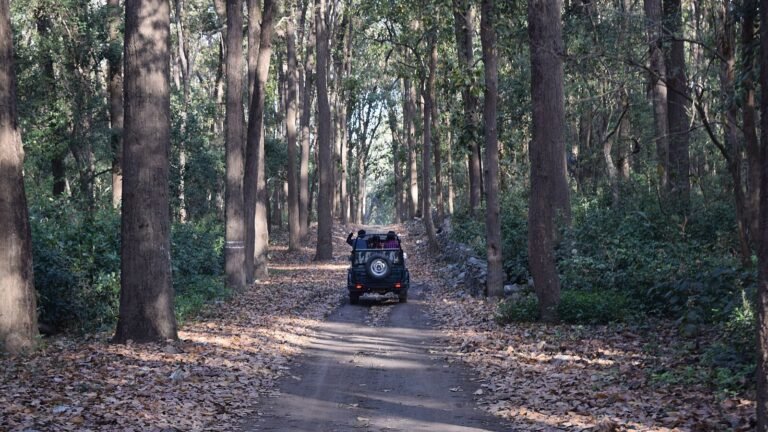
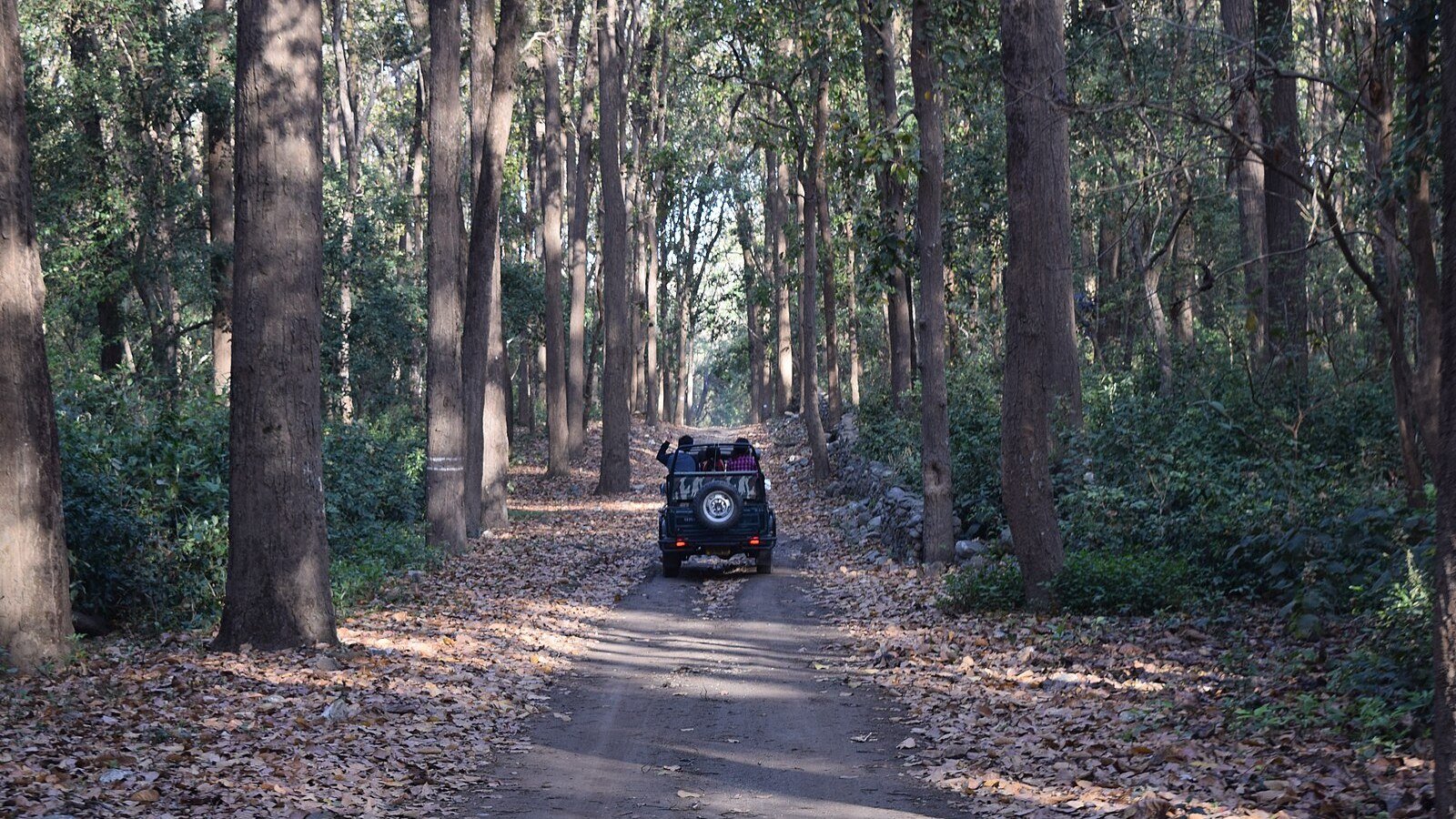
Photo: a safari jeep on a forest track in the Jhirna zone, Jim Corbett National Park — Dushyant Kaushik, CC BY-SA 4.0, via Wikimedia Commons.