
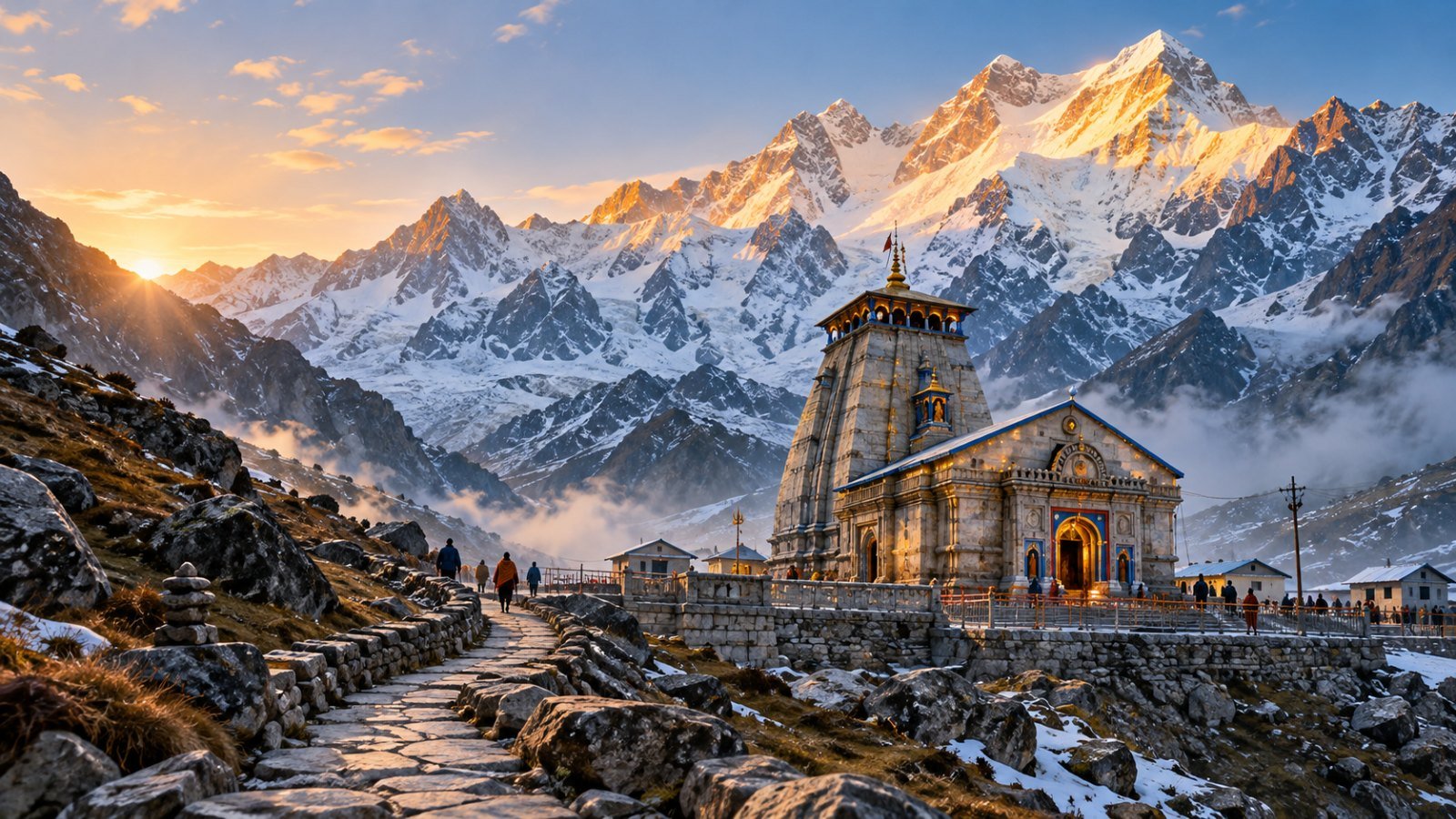
Kedarnath is the highest of the twelve Jyotirlingas, sitting at 3,583 m (11,755 ft) at the head of the Mandakini valley in Rudraprayag district. There is no road to it. Every pilgrim — whether walking, riding a pony, or flying — finishes the journey on foot or by helicopter, and every pilgrim must be registered before they start.
This guide covers the whole thing: when the temple opens and closes, how registration actually works, the road routes and driving times, the 16 km trek broken into stages, helicopter fares and booking rules, what a trip costs, and the mistakes that catch first-timers out.
Last verified: 25 October 2026, against the Uttarakhand Tourism registration portal and the IRCTC HeliYatra portal.
Kedarnath Yatra at a glance
| Altitude | 3,583 m / 11,755 ft — highest Jyotirlinga in India |
| District | Rudraprayag, Garhwal Himalaya, Uttarakhand |
| Road access | Up to Gaurikund only. Then 16 km on foot. |
| 2026 season | Opened 22 April 2026 · Closes 11 November 2026 (Bhai Dooj) |
| 2027 season | Opening date announced on Maha Shivratri, 6 March 2027 |
| Registration | Compulsory and free — registrationandtouristcare.uk.gov.in |
| Distance from Rishikesh | ~223 km by road + 16 km trek |
| Helpline | 1364 (toll free) · 0135-3520100 |
Kedarnath opening and closing dates
The temple does not follow the English calendar. Its opening and closing are fixed each year by the Badrinath-Kedarnath Temple Committee after Panchang calculations by the Rawal and Vedic scholars, and the opening date is announced publicly at the Shri Omkareshwar Temple in Ukhimath — the winter seat of Lord Kedarnath.
For 2026 the temple opened on 22 April and closes on 11 November. For 2027, expect the announcement around 6 March 2027 (Maha Shivratri), with opening likely in the last week of April or early May.
| Season | Opening | Closing | Notes |
|---|---|---|---|
| 2026 | 22 April 2026 | 11 November 2026 | Helicopter operations ran to 9 November |
| 2027 | To be announced 6 March 2027 | Generally Bhai Dooj, two days after Diwali | Booking opens after the date is confirmed |
When the doors close, the idols are carried down to Ukhimath and worship continues there for roughly six months. If you visit in winter, that is where darshan happens — not at Kedarnath.
Why you should not book before the date is announced
Every year, hotels and helicopter operators open “2027 bookings” in advance. The temple date is not a formality — it moves by up to two weeks between years, and helicopter services only operate inside the confirmed window. Book refundable accommodation early if you like, but hold the non-refundable helicopter and pony bookings until BKTC confirms.
Registration: mandatory, free, and checked in person
Pilgrim registration is compulsory for everyone — trekkers, pony riders, and helicopter passengers alike. It is free. There is no agent needed, and anyone charging you for “Kedarnath registration” is charging for something you can do yourself in five minutes.
There are four ways to register:
| Channel | How | Best for |
|---|---|---|
| Official portal | registrationandtouristcare.uk.gov.in | Most people — gives you a QR e-pass |
| Mobile app | Tourist Care Uttarakhand (Android / iOS) | Registering on the move |
| Send the word Yatra to +91-83948-33833 | Quickest if you dislike forms | |
| Offline counters | Haridwar, Rishikesh, Sonprayag, Guptkashi | Last-minute arrivals — expect queues |
What you need
- A government photo ID per person — Aadhaar is what the biometric check reads
- An active mobile number for OTP verification
- A passport-style photo upload
- Travel dates and your group composition
What you get
A registration number and QR-coded e-pass. For groups, you get a Group ID — keep it, because that same Group ID is what you enter when booking helicopter tickets later.
Where the check actually happens
At Sonprayag. Your QR e-pass is scanned and biometrics verified before you are allowed to move up towards Gaurikund. This is not a soft check; people without registration are turned back. Carry a printed copy as well as the digital one — network coverage at Sonprayag is unreliable when it is busy.
If you are driving
Vehicles need their own registration. Commercial vehicles and out-of-state private vehicles travelling the Char Dham route require a Green Card, issued after a vehicle fitness inspection through the Uttarakhand Transport portal. Private vehicles are also stopped at Sonprayag, where you park and take the shared jeep up to Gaurikund.
How to reach Kedarnath
Everything routes through the same funnel: Rishikesh → Devprayag → Srinagar (Garhwal) → Rudraprayag → Guptkashi → Sonprayag → Gaurikund. From Gaurikund the road ends and the trek begins.
| Starting from | Road distance | Driving time |
|---|---|---|
| Rishikesh | ~220 km | 9–10 hours |
| Haridwar | ~240 km | 9–10 hours |
| Dehradun | ~250 km | 9–10 hours |
| Badrinath | ~230 km | 9–10 hours |
| Uttarkashi | ~280 km | 11–12 hours |
| Gangotri | ~360 km | 14–15 hours |
These are hill-road times. In monsoon, add two to three hours for landslide halts. Do not plan a same-day arrival from Rishikesh and a trek start — you will be driving 9 hours and then climbing 1,600 m.
By train
No railway reaches Kedarnath. The practical railheads are Haridwar (best connected), Rishikesh, and Dehradun. From any of them it is a road journey of 9–10 hours.
By air
There is no airport at Kedarnath. The nearest is Dehradun (Jolly Grant). Charter helicopter services run from Dehradun for the Char Dham circuit. For most travellers, the practical “by air” option is the helicopter hop described below, which starts from a helipad near Guptkashi, not from a city.
Sonprayag to Gaurikund
The last 5 km. Private vehicles are not allowed up; you take a shared jeep (₹50–100 per seat, more in peak season). In heavy season this queue alone can cost you an hour. Reach Sonprayag before 6 am if you intend to trek the same day.
The 16 km trek from Gaurikund
The trail climbs from Gaurikund at 1,982 m to the temple at 3,583 m — a gain of about 1,600 m over 16 km. It is a well-made stone and concrete path the whole way, and it is genuinely tough on the lungs rather than the legs.
| Stage | Distance | Time | What to expect |
|---|---|---|---|
| Gaurikund → Jungle Chatti | 4 km | 1.5–2 hrs | Steady climb, first rest stop, tea stalls |
| Jungle Chatti → Bheembali | 3 km | 1–1.5 hrs | Forest section, gentler gradient |
| Bheembali → Lincholi | 3–4 km | 1.5–2 hrs | Open valley, exposed to weather |
| Lincholi → Kedarnath | 5–7 km | 2.5–3.5 hrs | Long final push, temple visible in the last hour |
Total: 6–8 hours walking for a reasonably fit adult. Fit trekkers do it in 5. People who have not walked uphill at altitude before should budget 8–9 hours and start at first light.
Pony, palki (doli) and pitthu
Mules (khachar), dandi-palkis and kandis are all booked through prepaid government counters at the Gaurikund mule stand: you pay the printed rate at the counter, not to the handler, and you get a slip. Rates are fixed each season by the Zila Panchayat Rudraprayag for dandi and kandi, and by the District Magistrate for mules, and are printed on boards at the stand. Anything arranged away from the counter is where overcharging happens — touts on the trail ask 30–50% above the board.
| Option | Up (Gaurikund → Kedarnath) | Down | Notes |
|---|---|---|---|
| Mule / pony | ₹3,200 | ₹2,300 | 3–4 hrs up. Same-day return ₹5,500 |
| Dandi / palki, up to 60 kg | ₹9,200 | ₹8,200 | 5–7 hrs. Weight slabs run to 120 kg (₹15,200) |
| Kandi (chair), up to 25 kg | ₹6,000 | ₹5,000 | 6–7 hrs. ₹8,000 if the passenger is up to 50 kg |
| Pitthu (porter, luggage only) | ₹1,000–1,500 | — | No printed card, so agree the bag rate first |
Pay at the counter and keep the slip. If someone quotes above the board, that is the moment to walk to the counter rather than argue on the trail later — the printed rate is the whole safeguard. Overcharging can be reported to the Uttarakhand Tourism toll-free helpline 1364 (emergency 112), which is the number printed on the official yatra portal.
Kedarnath by helicopter
Helicopters fly from three helipads — Phata, Sirsi and Guptkashi — all within an hour of Sonprayag by road. Tickets are sold only through the IRCTC portal at heliyatra.irctc.co.in. Any other website offering “official” helicopter tickets is a reseller at best.
| Helipad | Indicative round-trip fare (2026) |
|---|---|
| Sirsi | ~₹6,086 |
| Phata | ~₹9,680 |
| Guptkashi | ~₹12,154 |
Add a ₹300 IRCTC convenience fee and 18% GST on top of the base fare. The distance explains the price gap: Sirsi is closest to Kedarnath.
Rules that catch people out
- Registration comes first. You cannot book a helicopter ticket without a Char Dham registration number or Group ID from the Uttarakhand portal.
- Weight limit is 80 kg per passenger, weighed at the helipad before boarding pass issue. Excess is charged at ₹150 per kg, per person — it cannot be averaged across a group. Refuse to pay and you do not board.
- Only 2 tickets per user ID — maximum 6 passengers per ticket, 12 people per account. Larger groups need multiple accounts.
- Dynamic pricing is real. Booking 15–6 days out adds 20%; 5–1 days out adds 40%; same-day counter booking adds 50%. Early booking is materially cheaper.
- Children 2 and over pay full fare and get a seat. Infants under 2 travel free with no seat. Max 2 children + 2 infants per sortie.
- Original photo ID is mandatory at the helipad. Screenshots and half-printed tickets are treated as invalid.
- Weather cancellations are refunded to the source account in 5–7 working days, but you are not carried forward to the next slot — and you must get the ticket stamped at the helipad counter immediately.
A helicopter ticket buys you roughly 10 minutes in the air instead of a 16 km trek. It does not buy you darshan — you still queue at the temple like everyone else, and in peak season that queue can be several hours.
What a Kedarnath trip actually costs
Per person, from Haridwar or Rishikesh, three nights and four days:
| Style | Per person (approx.) | What it buys |
|---|---|---|
| Budget trek | ₹5,000 – ₹8,000 | Shared jeeps and buses, basic dharamshala or dormitory beds, self-guided, all walking |
| Comfortable | ₹12,000 – ₹20,000 | Private cab, hotel rooms in Guptkashi and Kedarnath, one-way pony, some meals included |
| Helicopter | ₹20,000 – ₹30,000+ | Return heli from Sirsi or Phata, hotel stay, transfers, no trekking |
The single biggest variable is the helicopter. The second is how many nights you spend in Guptkashi because you did not want to trek the same day you arrived. Most first-timers lose a day here — planning the drive to arrive by early afternoon saves both money and a night’s room.
Where to stay
- Kedarnath — GMVN guest house, private camps and dharamshalas. Basic, cold, and booked out weeks ahead in May–June. Worth one night if you want the evening aarti and the early-morning darshan without a pre-dawn climb.
- Gaurikund — the trek start. Functional rooms, useful if you want to begin walking at 5 am.
- Sonprayag — where the checkpoint is, and where vehicles stop. Good for a late arrival.
- Guptkashi — proper hotels, hot water, restaurants. The sensible base if you are flying or want comfort.
- Rudraprayag — a long day-trip from Kedarnath, but a good stop if you are doing the Char Dham circuit.
When to go
| Period | Conditions | Verdict |
|---|---|---|
| Late April – May | Snow on the upper trail, cold nights, moderate crowds | Good if you are prepared for snow underfoot |
| May – June | Peak season, busiest, warmest, clearest | Best weather, worst crowds and prices |
| July – August | Monsoon, landslide risk, leeches, low cloud | Avoid unless you have no choice |
| September – early November | Clear skies return, thinner crowds, cold nights | The best all-round window |
If you can choose, go in the second half of September. The monsoon clears, the valley is green, the queue is half what it is in June, and the temple is fully accessible.
What to pack
Layers, not bulk. The temperature at the temple is routinely 15–20°C colder than Rishikesh, and the weather changes fast in the afternoon.
- Base layer, fleece, and a windproof/waterproof shell
- Broken-in shoes with grip — the stone path is slippery when wet
- Rain poncho (an umbrella is useless in valley wind)
- Sunscreen and sunglasses; the UV at 3,500 m is harsh
- 1–2 litres of water, refillable — plastic is banned on the trail
- Dry fruits, ORS, and any regular medication
- Power bank — charging points are scarce and unreliable
- Cash. ATMs above Guptkashi are unreliable.
Safety and rules
- Altitude is the real risk. If you feel breathless, dizzy or nauseous, descend. Do not push through a headache at 3,500 m.
- Start the trek early. Afternoon weather on the Lincholi stretch turns quickly, and you do not want to be on the exposed section in rain or darkness.
- No drones. Flying drones near the temple is prohibited.
- Single-use plastic is banned on the route.
- Mobile coverage is patchy above Sonprayag. Jio and Airtel work intermittently at Kedarnath; do not rely on it for bookings or payments.
- Medical help exists at Gaurikund, Lincholi and Kedarnath, but it is basic. Carry your own essentials.
Frequently asked questions
Is registration mandatory for Kedarnath?
Yes. Every pilgrim must register — trekkers, pony riders and helicopter passengers. It is free, and the QR e-pass is scanned with biometric verification at Sonprayag before you are allowed to proceed.
What is the Kedarnath opening date for 2027?
It will be announced on Maha Shivratri, 6 March 2027, at the Shri Omkareshwar Temple in Ukhimath by the Badrinath-Kedarnath Temple Committee. Based on the lunar calendar it will most likely fall in the last week of April or early May 2027.
How far is the Kedarnath trek?
16 km one way, from Gaurikund (1,982 m) to the temple (3,583 m). It takes 6–8 hours for a reasonably fit adult, and the trail is paved the entire way.
Can I reach Kedarnath by road?
No. The road ends at Gaurikund. From there it is a 16 km trek, or a helicopter from Phata, Sirsi or Guptkashi.
How much does the Kedarnath helicopter cost?
In 2026, round-trip fares were roughly ₹6,086 from Sirsi, ₹9,680 from Phata and ₹12,154 from Guptkashi, plus a ₹300 IRCTC fee and 18% GST. Booking early avoids the 20–50% dynamic pricing surcharge.
Is one day enough for Kedarnath?
No, realistically. A same-day return means trekking up and down 32 km in one day, which most people cannot do safely at altitude. Plan two nights minimum from Haridwar, or one night at Kedarnath itself.
Do I need a medical certificate?
There is a health declaration as part of registration, and travellers with heart conditions, uncontrolled blood pressure or recent surgery should get medical clearance before attempting 3,583 m. There is no mandatory fitness test at the checkpoint.
Can I visit Kedarnath in winter?
No. The temple closes in November and the idols move to Ukhimath, where darshan continues through the winter months.
Planning your Kedarnath trip
The season runs only about six and a half months, and the good months — May, June and September — fill up early. If you are travelling as a group and want the driving, stays and helicopter slots handled together, that is what we put together for people heading to Kedarnath and the wider Char Dham circuit. Get in touch with your dates and group size and we will tell you honestly whether your plan is realistic.
Fares, rates and dates in this guide are verified against official sources as of 25 October 2026. Pony and helicopter prices change each season — always confirm on the IRCTC HeliYatra portal or at the Gaurikund counters before paying.
