
The Char Dham packing list that matters is short: three layers you can add and subtract, one pair of broken-in shoes with real grip, a rain shell that lives at the top of the bag, your prescription medicines in their original strips, and a document pouch that never leaves your body. Everything else is either sold at Gaurikund or can stay in the car. That kit weighs 8.5 kg on your back — 6.1 kg inside the rucksack and 2.4 kg worn — and it works for a seven-day circuit, a twelve-day one, and a helicopter trip where the airline only lets you carry five.
Short answer: one 40–45 litre rucksack per person plus a 20-litre daypack, 6–7 kg in the bag, no hard trolley. On a helicopter the allowance drops to a 5 kg soft bag, weighed at the helipad. For Kedarnath, the bag does not go up the 16 km trail with you unless you pay a pitthu — plan for a daypack and leave the rest in a locker or your room at Gaurikund.
Last verified: 8 November 2026 — against the Uttarakhand Department of Medical Health and Family Welfare’s Swasth Satark Safal Yatra advisory, the Kedarnath and Badrinath temple committee’s 2026 phone restriction, the Chief Minister’s Office briefing on the plastic-free yatra, Pawan Hans baggage terms as republished by IRCTC HeliYatra, and this site’s Kedarnath and registration guides. Where a figure is a 2026 rate rather than a 2027 one, the sentence says so.
First decide which of the four trips you are packing for
There is no single Char Dham packing list, because there is no single Char Dham. A family in a private car, a pilgrim on a GMVN coach, a helicopter passenger and someone walking every leg are all on the same circuit with the same temples, and their bags are nothing alike. The constraint is never the mountain; it is the leg where your transport stops and you keep going.
| How you travel | Practical limit | What that means for packing |
|---|---|---|
| Private car or self-drive | No weight limit, but the boot is shared by everyone | Two bags per person: a soft holdall that lives in the car and a 25–30 L daypack for the Kedarnath and Yamunotri legs. Nothing rigid at the back of the boot — it is the first thing that has to come out on a one-lane road |
| Package tour coach or tempo traveller | Luggage travels strapped on the roof, loaded and unloaded twice a day | One bag, soft-sided, with a rain cover and your name on it. A 60 L rucksack is easier to sling on a roof rack than two stacked trolleys |
| Helicopter charter (full circuit) | 5 kg soft bag per passenger; body weight free to 80 kg, then charged per kilogram | No trolleys, no hard cases, no loose carrier bags. At 88 kg body weight the excess is ₹1,200 at the published ₹150 per kg — weigh yourself at home, not at the helipad |
| IRCTC Kedarnath shuttle (Phata, Sirsi, Guptkashi) | Same soft-bag rule, and the flight can be cancelled on weather | Assume the flight does not happen and you walk or ride instead: shoes and a rain shell go in the bag you would carry on the trail, not the one left at the hotel |
| Walking the whole circuit | Whatever you can carry for six hours a day at altitude | 40–45 L, 6–7 kg in the bag, with laundry every third day. Two of everything, three of socks |
The five-kilogram rule is five kilos of bag; body weight is a separate allowance with its own per-kilogram charge, and both are enforced at the helipad with a scale.
Layers, not bulk
The four shrines sit between 3,100 m and 3,583 m, and the temple at Kedarnath runs 15–20°C colder than Rishikesh on the same afternoon. A single heavy jacket is the wrong answer to that, because you will be too hot at Joshimath and still cold at 5:00 AM at the temple. Four thin layers let you match the hour instead of the season.
| Layer | What to bring | Why it earns its weight | How many |
|---|---|---|---|
| Base | Merino or polyester T-shirt, full-sleeve | Dries while you are still wearing it. Cotton stays wet for hours at altitude, and a wet base layer is how a good day turns into a shivering one | 2 |
| Thermal bottom | Light merino or synthetic leggings | The single most under-packed item. Legs stay cold on a pony, in an open jeep before sunrise, and in unheated rooms above 3,000 m | 1 |
| Mid | 100–200 weight fleece or a thick hoodie | Does the work from 3:30 PM onwards and inside every hotel dining room on the route | 1 |
| Insulation | Light down or synthetic-filled jacket | Packs to the size of a water bottle and is what you actually put on for the 4:00 AM queue at Kedarnath | 1 |
| Shell | Windproof, water-resistant jacket plus a poncho | Stops wind on the pony and rain on the walk. The poncho goes over the rucksack; the jacket goes under it | 1 each |
| Lower body | Stretch trekking trousers, not jeans | Jeans are heavy wet, slow to dry and restrictive on a 16 km descent | 2 |
| Extremities | Woollen cap, gloves, neck gaiter, 4 pairs of socks | You lose heat through the head and hands faster than anywhere else, and dry socks are the cheapest blister prevention there is | 1 set + 4 pairs |
One traditional outfit per person belongs in the bag as well — a kurta-pyjama, a salwar-kameez, a sari, whatever you would wear to a temple at home. Not because there is a written dress code with a guard at the gate, but because shoulders and knees covered is what every one of these shrines expects, and because a dry clean set after a wet trek is the difference between darshan and a rushed one.
What the temples expect you to wear, and what they will take off you
Shoes come off before the sanctum at all four shrines, and at Kedarnath and Badrinath that means leaving them at a counter or in a locker a few hundred metres from the queue. Wear something you can slip off and carry, and do not wear your only pair of socks on the day you plan to walk in.
Two restrictions from the 2026 season are worth packing around. The Badrinath-Kedarnath Temple Committee banned mobile phones inside the Kedarnath temple premises for the 2026 season, with photography and reels inside the complex treated as a violation — so the phone stays in the bag or the locker, and your group needs a meeting point that does not depend on a call. Separately, after the October 2026 helicopter crash near Joshimath, the police and district administrations across the state were directed not to grant permission for drone operations near the temples or along the helicopter routes. A drone on this trip is dead weight with a confiscation risk attached.
Where a locker is offered at the queue line, use it rather than negotiating at the barrier.
Footwear is the one item worth spending on
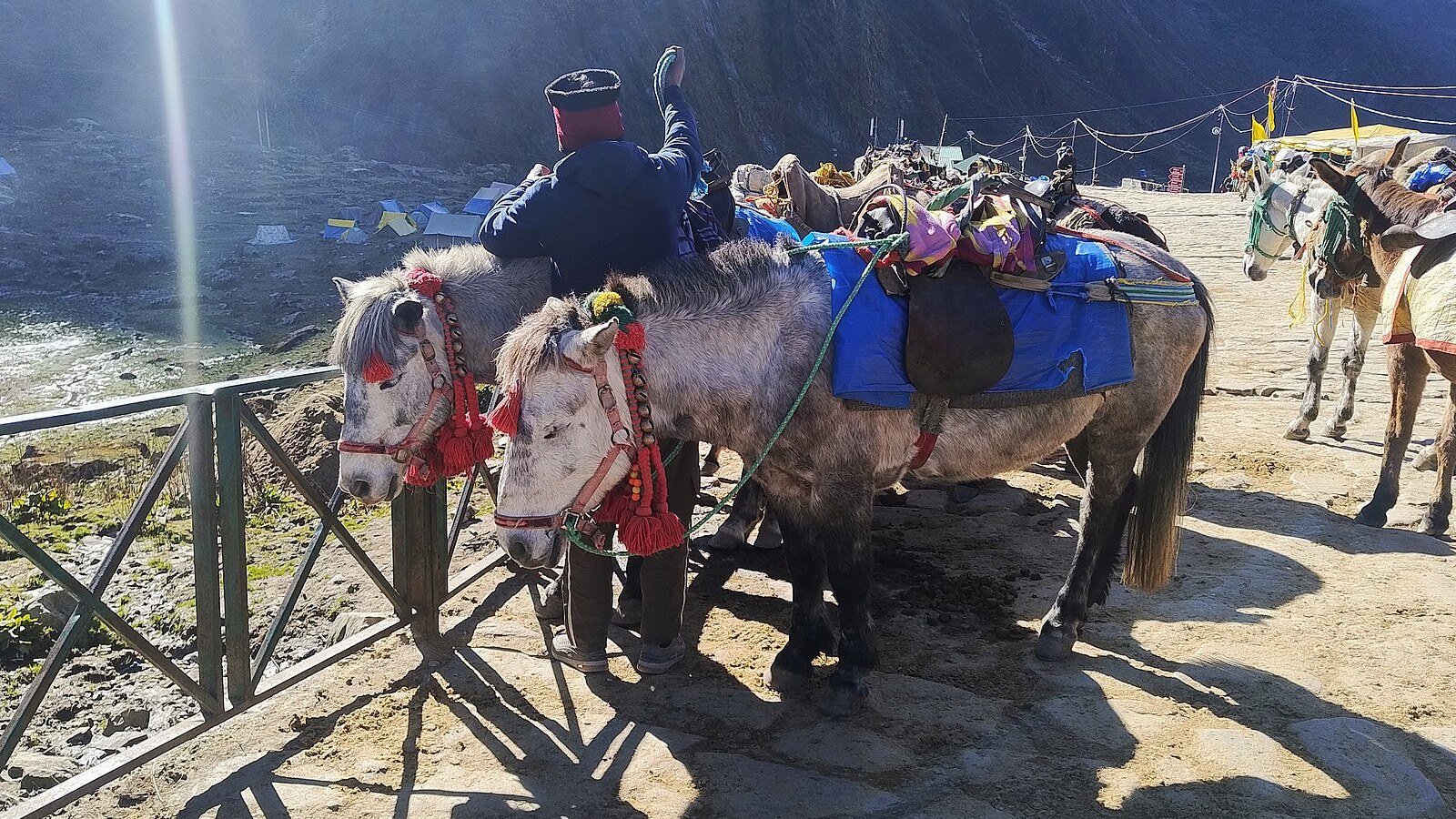
Three of the four legs are walked on hard, steep, mule-worn surfaces. The Kedarnath trail is 16 km each way from Gaurikund, with a gradient that never lets up and a surface that alternates between concrete, loose stone and animal traffic. Yamunotri is a 5–6 km climb from Janki Chatti, steeper per kilometre than Kedarnath and just as hard on the knees coming down. Gangotri and Badrinath are steps and cold stone in front of the temple, which is its own kind of slip hazard in the wet.
What works: a trail shoe or light trekking boot with a deep lug pattern, bought at least a month before the trip and worn on errands until the heel does not need thinking about. What does not: running shoes on the descent, sandals beyond Gaurikund, and anything bought in the last week. Gumboots are sold and rented at Gaurikund through the monsoon — right for knee-deep slush on the first two kilometres, wrong for 16 km, because they neither breathe nor flex. Pack the sandals anyway: every hotel on the route is a shoes-off building.
Rain, sun and altitude: the same bag for three problems
At 3,000 m the sun burns through cloud in twenty minutes and the weather turns in ten. The advisory issued by the state health department puts it plainly: expect cold, low humidity, intense UV radiation, reduced air pressure and reduced oxygen. Those four facts generate half of your packing list.
| Shrine | Altitude | What that adds to the bag |
|---|---|---|
| Yamunotri | 3,291 m | The coldest nights of the circuit at the Janki Chatti end; thermals and a cap even in June, and a trekking stick for the 5–6 km descent |
| Gangotri | 3,100 m | Road reaches the door, so a spare dry set stays in the vehicle. The Bhagirathi wind at the temple is the coldest thing on the circuit that is not at altitude |
| Kedarnath | 3,583 m | The high point. Down jacket, gloves, rain shell and a change of base layer at the top; the one place where a wet arrival genuinely costs you the evening |
| Badrinath | 3,133 m | Cold stone underfoot at the queue and a hot spring at Tapt Kund next door — carry a towel and a dry set if you plan to bathe |
The specific items: a 50 SPF sunscreen stick, a lip balm with sunscreen, and sunglasses with real UV filtering. UV at this altitude is not a comfort issue — snow blindness and sunburned eyelids are common enough on the Kedarnath trail that every medical post knows them. Then a rain shell, a poncho that covers the rucksack, and two zip-lock bags, one for documents and one for the phone. A wet registration QR code is a real problem at a checkpoint, and a phone that dies of water at 3,500 m was a map, camera, payment app and emergency line all at once.
The medicine kit the health advisory actually implies
The state’s advisory is written for pilgrims, not doctors, and it is specific in a way most packing lists are not. It asks for a yatra of at least seven days, rest of 5–10 minutes for every hour of trekking and every two hours of driving, and no more than 800–1,000 m of elevation gain in a day. It names the groups who should be screened before travelling: people over 55, anyone with a history of heart disease, hypertension, asthma or diabetes, anyone with a BMI above 30, and pregnant women. And it lists the symptoms that mean stop and descend — chest pain, shortness of breath, persistent cough, dizziness or disorientation, vomiting, bluish lips or fingertips, weakness or numbness on one side of the body.
| Item | Why it is in the bag | Note |
|---|---|---|
| Prescription medicines | The advisory asks pilgrims with a medical history to carry prescribed medication and their doctor’s contact details | Original strips with the label, plus three extra days. There is no pharmacy at Kedarnath that will have your molecule |
| Pulse oximeter | The advisory’s threshold is a saturation below 90 per cent — seek help at the nearest medical relief post | A ₹1,000 fingertip unit, 50 g, and the single most useful diagnostic tool a family can carry |
| ORS sachets | Dehydration and headache at altitude look like altitude sickness and often are not | Four to six sachets. Also the fastest fix for a child who has stopped drinking |
| Paracetamol | Headache, fever, the ache that follows 8 hours in a jeep | Carry what you would take at home; do not experiment with a new drug on the mountain |
| Blister plasters and tape | Blisters end more Kedarnath walks than altitude does | Apply at the first hot spot, not at the first blister, and tape the heel before the descent |
| Crepe bandage or knee support | The descent from Kedarnath and Yamunotri is where knees give out | One per person over 50, for the downhill leg only |
| Motion sickness tablets | The Rudraprayag and Joshimath stretches are continuous curves for hours | Take before the drive, not after. Ask a pharmacist which one does not sedate |
| Antacid and a mild laxative | Hill food, changed water and a disrupted routine | Bottled or filtered water throughout; do not test the local supply on a trek day |
| Diamox (acetazolamide) | It is the standard prophylactic for acute mountain sickness | Prescription only. Carry it if your doctor prescribes it, with their instruction on when to start — not because a blog said so |
| Inhaler and any cardiac medication | Asthma and heart disease are two of the advisory’s named high-risk conditions | Two of each, one in the daypack and one in the main bag, so a lost bag is not a lost lifeline |
What the kit does not replace is judgement: the advisory’s instruction is to descend rather than ascend, and to let a doctor at the nearest relief post decide the level of care. Screening points and medical relief posts sit on all four routes, and in 2026 the state reported 177 ambulances on the yatra including advanced life support units, with a helicopter ambulance service run with AIIMS Rishikesh.
Documents: the paper that actually gets checked
A printed QR e-pass is not bureaucracy, it is the thing that gets you past Sonprayag. The registration is free, done on the state portal or the Tourist Care Uttarakhand app or by sending “Yatra” on WhatsApp, and it collects a photograph, a government ID and a health declaration per pilgrim. Carry it twice — on the phone and on paper — because the phone is the item most likely to be wet, dead or locked in a temple locker.
| Document | Form | Where it is checked |
|---|---|---|
| Yatra registration e-pass (QR) | Printed, plus a PDF on the phone | Sonprayag checkpost and again at the shrine; group registration covers everyone on the pass, so one printout per group and one copy per adult is the safe split |
| Government photo ID | Aadhaar, voter ID or passport, original | Biometric verification at Sonprayag and at hotel check-in. A photocopy will not do |
| Passport photographs | Four per person, printed | Offline registration counters and any re-issue of a pass; the one document nobody packs until they need it |
| Medical fitness certificate | Paper, signed, dated | Screening centres, and asked for at checkpoints from pilgrims over 55 or with a declared condition |
| Travel insurance | PDF, with the emergency number written on paper | Helicopter operators and hospitals; check that high-altitude trekking and helicopter evacuation are covered rather than assumed |
| Vehicle papers and permits | Originals in the glovebox | Green Card and route permits for private vehicles, checked on the highway; the driver carries these, not the passengers |
| Hotel and helicopter vouchers | Phone plus one paper copy | Helipads want the voucher and the body weight on the same booking; a cancellation in the family group is easier to argue with paper |
| Emergency contact card | Index card in the document pouch | Two numbers, blood group, allergies and current medicines, written for a stranger to read if you cannot speak |
The 8.5 kg weight budget
Weigh the bag at home, because the number is the whole discipline. This is what a seven-day road circuit actually comes to for one adult, with laundry once on the way and no camera kit beyond a phone.
| Item | Weight | Carried where |
|---|---|---|
| Clothing worn (base, mid, trousers, boots, cap) | 1,600 g | On you |
| Down jacket and fleece, worn or strapped on | 800 g | On you |
| Spare base layer, trousers, 3 pairs of socks | 1,100 g | Rucksack |
| Thermal bottom and one traditional outfit | 600 g | Rucksack |
| Rain shell and poncho | 500 g | Rucksack, top pocket |
| Medicine kit and oximeter | 400 g | Rucksack, with a duplicate strip in the daypack |
| Toiletries, sunscreen, lip balm | 400 g | Rucksack |
| Phone, power bank, cables, head torch | 600 g | Daypack |
| Document pouch | 200 g | On you, always |
| Water, 1 litre | 1,000 g | Daypack, refilled twice a day |
| Dry fruit, biscuits, electrolyte tablets | 500 g | Daypack |
| Sandals for rooms | 400 g | Strapped outside the rucksack |
| Laundry bag and miscellany | 400 g | Rucksack |
| Total in the bag | 6,100 g | Rucksack and daypack |
| Total carried, including worn clothing | 8,500 g | On your back, both feet, one load |
Excess weight is almost always shoes, camera gear or “just in case” clothing — cut the third pair of shoes before you cut the rain shell. On a helicopter this list does not fit five kilograms as written: wear the jacket and boots on board, put medicines, documents and one spare set in the soft bag, and leave the rest in Dehradun.
What you can buy on the route, and what you cannot
Uttarakhand’s yatra route is a market for exactly the things pilgrims forget. Woollens, ponchos, walking sticks, thermals, gloves and rubber boots appear at Guptkashi, Sonprayag, Janki Chatti, Uttarkashi and Joshimath, and the prices fall as you get further from the towns. What does not appear is anything specific to you.
| Item | Buy on the route? | Where, and the catch |
|---|---|---|
| Woollens, fleece, caps, gloves | Yes | Guptkashi, Uttarkashi and Joshimath have the widest choice; Gaurikund and Janki Chatti sell only the cheap end at trailhead prices |
| Poncho or raincoat | Yes | Sold at every trailhead, and the thin ones tear within a day. Bring a real shell from home and treat the local one as a spare |
| Trekking stick or bamboo staff | Yes | Gaurikund and Janki Chatti, a few hundred rupees, and genuinely useful on the descent. Buy it there rather than flying with one |
| Trekking shoes | Only as an emergency | What is sold on the route is unbranded and unbroke-in. A new pair bought at Gaurikund is how you get blisters by Lincholi |
| Socks and thermals | Yes | Widely available and cheap; check the seams, because the bargain pairs are the ones that rub |
| Sunscreen and lip balm | Unreliable | Stock appears in Guptkashi and Joshimath but the SPF is often unstated. Bring your own |
| Your prescription medicines | No | Pharmacies thin out above Guptkashi and Joshimath, and none at Kedarnath. This is the one category where “buy it there” is not an option |
| Power bank, cables, memory cards | No | Charging points exist but are contended, and a cold battery drains twice as fast. Carry the capacity you need from home |
| Bottled water | Yes, but | Everywhere, and the yatra is being pushed towards plastic-free: the Chief Minister’s 2026 review ordered collection boxes along the routes and strict curbs on plastic use. Carry a refillable bottle and use the taps and filters where they exist |
What to leave behind
| Item | Why it stays home |
|---|---|
| Hard trolley or suitcase | Refused at helipads, useless on a pony, and it will not fit in a shared jeep boot on the Sonprayag run |
| More than two pairs of shoes | Boots on, sandals for the room. A third pair adds a kilogram and gets worn once |
| Single-use plastic bottles and bags | The state’s Green and Clean campaign is actively enforcing a plastic-free yatra with collection boxes and inspections along the route |
| Drone | Police and district administrations were directed in November 2026 not to permit drone operations near the temples or along the helicopter corridors |
| Laptop and work kit | One and a half kilograms, no reliable power at the top, and every hour of it is a day you did not spend looking at the valley |
The 72-hour checklist
Three days out, in this order: weigh the bag on a luggage scale and cut until it reads 6–7 kg; charge the power bank and the torch; count the medicines against the days of the trip and add three; print the e-pass, the insurance and the emergency contact card, and put them in one pouch; check the registration QR still resolves; tell your bank you are travelling if you are relying on a card; and re-read the district weather alert the night before you leave. The night before departure, pack the daypack as if the main bag will be separated from you, because on this circuit it eventually is.
Two hours into any yatra plan, somebody discovers they have the wrong shoes or no rain shell. Both are somewhere on the day-by-day itinerary as a fixed stop, so read that next if you have not decided how many days to give the circuit. The cost guide prices the same trip, the 2027 hub tracks the dates, and the best-time guide tells you which month to pack this bag for — the monsoon version needs the shell and a second pair of socks, the October version needs the down jacket and gloves.
Frequently asked questions
How much luggage can I take on a Char Dham helicopter?
Five kilograms in a soft bag per passenger, weighed at the helipad. Hard trolleys and loose carrier bags are refused. Your body weight is a separate allowance — 80 kg free, then charged per kilogram, ₹150 per kg in the published 2026 terms, so an 88 kg passenger pays ₹1,200. Wear your jacket and boots on board to keep the bag inside five kilos.
Is there a dress code at Kedarnath and Badrinath?
No written code with a guard at the gate, but shoulders and knees covered is what all four shrines expect, and traditional clothing is the norm inside the sanctum. Shoes come off before entry. Since the 2026 season, mobile phones are not allowed inside the Kedarnath temple premises, so plan a meeting point that does not rely on a call.
Do I need a medical certificate for the Char Dham Yatra?
Not for everyone, but the state health advisory asks pilgrims over 55, anyone with heart disease, hypertension, asthma or diabetes, anyone with a BMI above 30, and pregnant women to get a fitness check-up before travelling. Screening is available at centres along the route, and a certificate in hand speeds that up. Carry your prescriptions in their original packaging either way.
Should I carry a portable oxygen cylinder?
Not as a substitute for acclimatisation. Cans are sold along the trail, and a pulse oximeter is a better use of the same money. The advisory’s instruction is to descend if you feel unwell rather than to ascend with oxygen, and to let a doctor at the nearest medical relief post decide the level of care. If you have a diagnosed lung or heart condition, carry what your doctor prescribes.
How many pairs of shoes should I pack?
Two: one broken-in pair of trail shoes or light boots for the walking, and sandals for hotel rooms and temple queues. A third pair is dead weight. Do not buy the walking pair in the last week before the trip — blisters start with new shoes, not with old ones.
Can I take a trolley bag to Kedarnath?
You can take it as far as Gaurikund, and no further unless you pay a porter. There is no road above Gaurikund, so luggage goes up 16 km by pitthu or mule — porters charge roughly ₹1,000–1,500 per bag with no printed card, so agree the rate before the bag is lifted. The practical answer is a daypack up and the bag left in your Gaurikund room or a locker.
What documents must I carry on the yatra?
The registration QR e-pass on paper and on the phone, an original government photo ID, passport photographs, a medical certificate if you are in the advisory’s high-risk group, insurance details with a written emergency number, vehicle permits if you are driving, and hotel or helicopter vouchers. Keep them in one pouch that stays on your body.
What should I not carry on the Char Dham Yatra?
Hard trolleys, single-use plastic, drones, a laptop, a heavy camera kit and more than two pairs of shoes. Drones were specifically shut out of temple areas and helicopter corridors by district-level instructions in November 2026, and the plastic-free yatra campaign means bottles and bags are the thing you will be asked about at collection points.
How much water should I carry each day?
One litre on the person and a refill point planned, which on the Kedarnath trail means Gaurikund, Jungle Chatti, Bimbali and Lincholi. The advisory asks for regular fluids, preferably lukewarm, and warns against alcohol and caffeine. On a 16 km day at altitude, two litres over six hours is the honest figure.
What should I wear for the Kedarnath trek in 2027?
Base layer, fleece, windproof shell, trekking trousers and broken-in shoes, with the down jacket and gloves in the bag for the top. The temple at 3,583 m runs 15–20°C colder than Rishikesh, and the weather turns in the afternoon. In the monsoon add the poncho and a dry spare base layer; in October add the thermals and a warm cap.
Baggage allowances, pony and porter rates and the health advisory’s thresholds are the 2026 figures, verified 8 November 2026 against IRCTC HeliYatra, the Zila Panchayat Rudraprayag and District Magistrate rate cards, and the Uttarakhand Department of Medical Health and Family Welfare. Seasonal rates and 2027 rules change — check the helipad scale and the advisory again in the week you travel.

1 comment on “Char Dham Yatra Packing List 2027: What to Carry”