
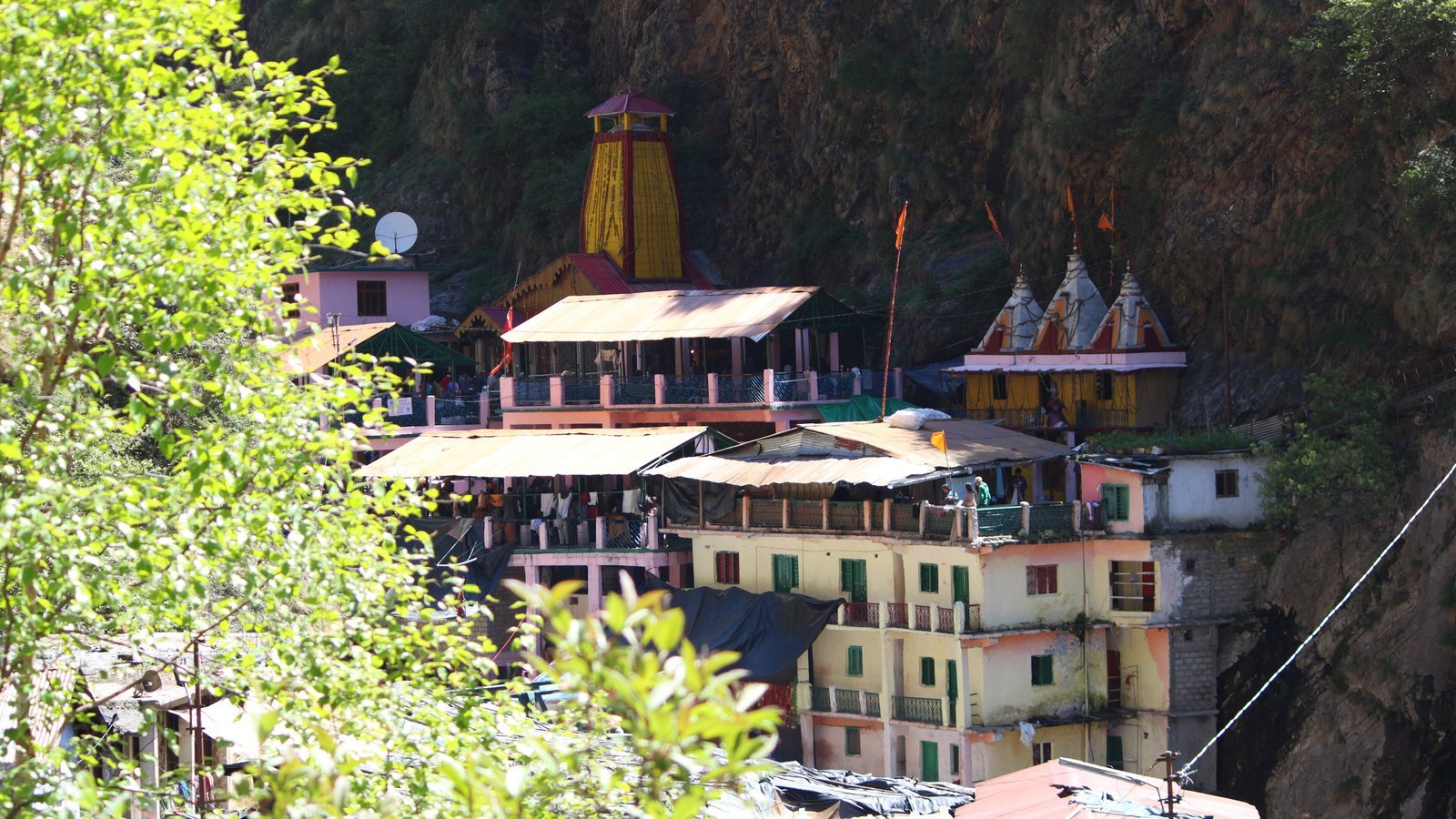
This is the first dham in the traditional Char Dham order. Also on the site: the Gangotri Yatra 2027 guide, which opens and closes on the same dates as Yamunotri.
यह गाइड हिंदी में भी उपलब्ध है: यमुनोत्री यात्रा 2027 — पूरी हिंदी गाइड.
Yamunotri is the smallest, oldest and least convenient of the four Char Dham shrines, and the only one where the road stops 6 km short. It sits at 3,291 m (10,800 ft) on the western flank of Bandarpunch, in Uttarkashi district, at the foot of the Champasar glacier that feeds the Yamuna. The actual source is a frozen lake about a kilometre above the temple and it is not accessible — the shrine stands where pilgrims can actually reach.
This guide to the Yamunotri Yatra 2027 covers what is known and what is not: the opening and closing dates, how the free registration works and where it is checked, the drive from Rishikesh and Dehradun with realistic timings, the 6 km climb from Janki Chatti in stages, pony and palki rates at the prepaid counter, helicopter charters to Kharsali, darshan timings, what the trip costs, and the mistakes that cost first-timers a day.
Quick answer: Yamunotri opened on 19 April 2026, on Akshaya Tritiya, and closes on 11 November 2026 at 10:28 AM on Bhai Dooj. The 2027 season opens on Akshaya Tritiya, 9 May 2027, with the muhurat fixed by the Yamunotri Temple Committee a few weeks before. Registration on registrationandtouristcare.uk.gov.in is free and compulsory, and it is checked at Janki Chatti before the trek. The road ends at Janki Chatti; the temple is a 6 km climb, 2–3 hours up, and there is no ropeway yet.
Last verified: 30 October 2026, against the Uttarakhand Tourist Care registration portal’s Yamunotri dham page, the Shri Badrinath-Kedarnath Temple Committee’s Yamunotri pages, and the Yamunotri Temple Committee’s closing-date announcement of 20 October 2026.
Yamunotri Yatra 2027 at a glance
| Detail | Yamunotri 2027 |
|---|---|
| Altitude | 3,291 m / 10,800 ft — below the Bandarpunch flank |
| District | Uttarkashi, Garhwal Himalaya, Uttarakhand |
| Deity | Yamuna, in black marble — the river’s source shrine |
| Road access | Motorable to Janki Chatti only. Then 6 km on foot. |
| 2026 season | Opened 19 April 2026 · Closes 11 November 2026, 10:28 AM (Bhai Dooj) |
| 2027 season | Opens Akshaya Tritiya, 9 May 2027 · closes around Bhai Dooj, late Oct / early Nov |
| Registration | Compulsory and free — registrationandtouristcare.uk.gov.in |
| Distance from Rishikesh | ~205 km by road + 6 km trek |
| Trek | Janki Chatti 2,650 m → temple 3,291 m, 5–6 km, 640 m gain |
| Winter seat | Kharsali, 1 km from Janki Chatti |
| Helplines | 1364 (tourist) · 1077 (disaster) · 108 (ambulance) |
When does Yamunotri temple open and close?
Unlike Kedarnath and Badrinath, whose dates are announced at Maha Shivratri and Basant Panchami, the Yamunotri opening is a calendar event: the doors open on Akshaya Tritiya, the third day of the bright half of Vaishakha, which can be calculated years ahead. What the Yamunotri Temple Committee actually fixes — at its meeting at Kharsali in March or April — is the muhurat, the exact hour on that day, along with the season’s darshan timetable.
In 2026 the doors opened on 19 April, on Akshaya Tritiya, the same day as Gangotri. The closing date was settled on Vijayadashami, 20 October 2026, at a meeting of the temple committee and the priest community at Yamunotri: the doors shut on 11 November 2026 at 10:28 AM, on Bhai Dooj. For 2027, Akshaya Tritiya falls on 9 May, and the season should end in the last week of October or the first week of November.
| Season | Opening | Closing | Notes |
|---|---|---|---|
| 2026 | 19 April 2026 (Akshaya Tritiya) | 11 November 2026, 10:28 AM (Bhai Dooj) | Closing muhurat fixed at Yamunotri on Vijayadashami |
| 2027 | 9 May 2027 (Akshaya Tritiya) | Around Bhai Dooj — expect 10–14 November | Muhurat and daily timings announced in April 2027 |
Why the two dates are decided differently
The opening is arithmetic — Akshaya Tritiya is a tithi, not a decision — but the hour it happens is not, and the closing date is a committee call taken in autumn once the snow line and the pilgrim count are known. That is why hotels and helicopter operators confidently advertise “2027 bookings” while the temple itself will not confirm an hour until spring. Book refundable stays early if you like; hold non-refundable pony and helicopter money until the committee publishes.
Do you need registration for Yamunotri?
Yes, and it is the same free Char Dham registration as the rest of the circuit. Every pilgrim — trekker, pony rider, palki passenger, helicopter arrival — needs a QR-coded e-pass with biometric details. There is no fee, no agent required, and anyone charging you for “Yamunotri registration” is charging for a form you can fill in yourself in five minutes.
| Channel | How | Best for |
|---|---|---|
| Official portal | registrationandtouristcare.uk.gov.in | Most people — issues the QR e-pass instantly |
| Mobile app | Tourist Care Uttarakhand (Android / iOS) | Registering on the move |
| Send the word Yatra to +91-83948-33833 | Quickest if you dislike forms | |
| Offline counters | Haridwar, Rishikesh, Barkot, Janki Chatti | Last-minute arrivals — expect queues |
What you need
- A government photo ID per person — Aadhaar is what the biometric check reads
- An active mobile number for OTP verification
- A passport-style photo upload
- Travel dates and everyone’s name and age in the group
What you get
A registration number and a QR-coded e-pass, and for groups a single Group ID covering everyone. Keep that ID: it is what you quote if you later add helicopter seats or need to reprint at a counter.
Where the check actually happens
At Janki Chatti, at the entry to the trek, where the e-pass QR is scanned and identity checked before anyone is allowed up the path. This is a real check, not a formality; unregistered pilgrims are turned back. Carry a printed copy as well as the phone copy, because the network at Janki Chatti is unreliable exactly when it is busiest.
If you are driving
Vehicles on the Char Dham route — commercial, and out-of-state private cars — need a Green Card, issued after a fitness inspection through the Uttarakhand Transport portal. Uttarakhand-registered private cars are stopped for papers but do not need the card. Parking at Janki Chatti is paid and fills by 8 AM in May and June; the alternative is to park in Barkot and take a shared jeep up.
How do you reach Yamunotri?
Everything funnels through Rishikesh → Narendra Nagar → Chamba → Dharasu → Barkot → Sayana Chatti → Ranachatti → Janki Chatti. The road is motorable the entire way and ends at Janki Chatti, where the trail begins. Do not plan the drive and the trek on the same day — 205 km of hill road plus 640 m of climbing is how people end up doing the last kilometre in the dark.
| Starting from | Road distance | Driving time |
|---|---|---|
| Rishikesh | ~205 km | 7–8 hours |
| Haridwar | ~220 km | 7.5–8.5 hours |
| Dehradun | ~165 km | 6–7 hours |
| Barkot | ~45 km | 1.5 hours |
| Uttarkashi | ~123 km | 4 hours |
| Gangotri | ~222 km | 8 hours |
| Sonprayag (Kedarnath route) | ~380 km | 11–12 hours |
Those are free-flowing-road figures. In the season, add an hour each way for the single-lane stretches between Dharasu and Barkot, and two to three hours in monsoon for landslide halts. The Gangotri and Yamunotri legs share the same approach as far as Dharasu, which is why most itineraries do them together — the Gangotri guide has the other half of that loop.
By train
No railway reaches Uttarkashi district. The practical railheads are Haridwar (best connected), Rishikesh and Dehradun. From any of them it is the road journey above, so an overnight train arriving at Haridwar at dawn is the efficient version.
By air
The nearest airport is Dehradun (Jolly Grant), about 165 km and 6–7 hours by road. There is no scheduled helicopter service into the valley; the charter option lands at Kharsali, described below.
Buses and shared jeeps
Ordinary and GMOU buses run Rishikesh/Haridwar → Barkot through the day (about 8 hours), and shared jeeps cover Barkot → Janki Chatti in roughly 1.5 hours. Coming from Gangotri or Uttarkashi, you change at Dharasu or Barkot. Buses do not go beyond Janki Chatti — from there it is the trail.
How hard is the 6 km trek from Janki Chatti?
Janki Chatti sits at about 2,650 m and the temple at 3,291 m, so the 6 km climb gains 640 m — steeper than Kedarnath’s trek per kilometre, and almost all of it on stone steps. It is short, it is well made, and it still takes most pilgrims 2–3 hours up. Coming down takes 1.5–2.
| Stage | Distance | Time | What to expect |
|---|---|---|---|
| Janki Chatti → first ridge | ~2 km | 45–60 min | Steep stone steps straight out of the village; the hardest part on fresh legs |
| Ridge → Gauri Kund | ~1.5 km | 30–45 min | Easier gradient, tea stalls, pine and deodar shade |
| Gauri Kund → last bend | ~1.5 km | 45–60 min | Exposed climb above the treeline; weather changes fast here |
| Last bend → temple | ~1 km | 20–30 min | Surya Kund steam, the ashram roofs, and the final steps to the gate |
Start by 7 AM The path is shared with ponies and palkis, which have right of way on the narrow sections, and by mid-morning the queue at the temple narrows the last stretch. Two more things worth knowing: the Gauri Kund on this trail is a hot spring on the Yamunotri path, not the Gaurikund that is the roadhead for Kedarnath — the names are identical and the two are 250 km apart. And the descent is harder on the knees than the climb; if you have bad knees, take a pony down rather than up.
Pony, palki and pitthu
Mules, dandi-palkis, kandis and porters are all booked at the prepaid counter at Janki Chatti, where the district administration posts the season’s fixed rates on a board. Pay the counter, take the slip, and do not negotiate on the path — the printed rate is the whole safeguard, and touts on the trail quote 30–50% above it.
| Option | Round trip | With night halt | Weight limit | Notes |
|---|---|---|---|---|
| Mule / pony | ₹3,500 | ₹3,750 | Up to 80 kg | 2–3 hours up. Plus a ₹150 management fee at the counter |
| Kandi / pitthu (porter) | ₹1,800 | ₹2,050 | Up to 40 kg | 3–4 hours. ₹2,700 for 40–60 kg |
| Palki / doli | ₹7,000 | ₹8,000 | Carried, 50 kg and above | 4–5 hours. Plus a ₹600 management fee |
Those are the posted 2026 rates, and they move a little each season. Up to 8,000 pilgrims a day use this path in May and June, so the counter queue at 7 AM can be 40 minutes on its own. Overcharging or a refused slip is reportable to the tourist helpline 1364 (emergency 112).
Is there a helicopter to Yamunotri?
Only as a charter, and it does not skip the trek. The nearest helipad is Kharsali, a kilometre from Janki Chatti across the river, and the 6 km climb to the temple is unchanged from there. Charter flights run from Sahastradhara helipad in Dehradun in about 30 minutes, and are sold as same-day packages by operators rather than as individual seats on a government portal the way Kedarnath helicopter tickets are.
For 2026 those packages were being quoted at roughly ₹80,000–95,000 per person for the Dehradun–Kharsali–Dehradun day, which buys the flight, ground handling and the same pony or walk you would have done anyway. If your reason for flying is a medical one — an elderly parent who cannot do 8 hours of hill road — it works. If you are trying to save time, the arithmetic usually fails: a road trip from Rishikesh the previous afternoon costs a fraction of that and gets you to the path earlier.
Weather is the other constraint. Kharsali departures are cancelled on low cloud and high wind, most often in July and August, and a cancelled flight is a refund, not a rebooking.
What is worth seeing around the temple?
The temple itself takes twenty minutes. The rest of Yamunotri is the hot springs, the rock that is worshipped before the deity, and the two villages on the way up — and it is these that people skip when they treat the dham as a tick-box.
| Place | Distance | Why bother |
|---|---|---|
| Surya Kund | At the temple | Scalding hot spring, close to boiling. Pilgrims tie rice and potatoes in muslin and boil them here to take home as prasad |
| Divya Shila | At the temple | The rock pillar worshipped before the deity — you are meant to pay respects here first |
| Gauri Kund | ~3.5 km below the temple | Warm spring on the trail where Parvati is said to have bathed. Not the Gaurikund near Kedarnath |
| Kharsali | 1 km from Janki Chatti | Winter seat of the goddess, with the old Shani temple the pujaris of Yamunotri serve at |
| Hanuman Chatti | On the way up | Confluence of the Hanuman Ganga and the Yamuna; the last tea stop before the climb |
| Barkot | 45 km from Janki Chatti | The only real market and ATM on this leg, and the sensible overnight before the trek |
What are the darshan timings?
The committee publishes the season’s timetable at the opening and it is not published in advance — the Uttarakhand registration portal’s Yamunotri page still listed the 2026 darshan and aarti times as pending after the doors opened. What follows is the pattern operators worked to in 2026; treat the exact minutes as indicative and confirm at Janki Chatti or the temple gate.
| Ritual | Approximate time | Notes |
|---|---|---|
| Doors open | 6:00 AM | Morning aarti shortly after; the quietest darshan of the day |
| Morning darshan | 6:30 AM – 12:00 PM | Best window before the pony traffic arrives |
| Bhog / midday break | 12:00 PM – 2:00 PM | Darshan pauses; plan the climb around it |
| Afternoon darshan | 2:00 PM – 7:00 PM | Longest queue after 4 PM in peak season |
| Evening aarti | 7:00 PM – 8:00 PM | Worth staying for — needs a night at Janki Chatti or the temple |
Phones and cameras
Cameras are not allowed inside the sanctum, and phones are expected to be off. Drones are prohibited anywhere on the route, and there is no photography of the deity — the same rules as the other three dhams, enforced more strictly here because the shrine is small.
What does a Yamunotri trip cost?
Per person from Haridwar or Rishikesh, three nights and four days, covering the drive up, two nights in the Barkot/Janki Chatti area and the trek. Yamunotri on its own is the cheapest of the four dhams; the cost of adding it to a Char Dham itinerary is mostly the extra day of vehicle hire.
| Style | Per person (approx.) | What it buys |
|---|---|---|
| Budget | ₹4,500 – ₹7,000 | Shared bus to Barkot, shared jeep up, basic rooms or dharamshala beds, walking both ways |
| Comfortable | ₹10,000 – ₹16,000 | Private cab from Rishikesh, hotel in Barkot or Janki Chatti, pony one way, meals included |
| Helicopter | ₹80,000 – ₹95,000 | Charter Dehradun–Kharsali–Dehradun in a day, ground handling, still 6 km on foot |
Three things move the number. Pony versus walking is about ₹3,500. Where you sleep — Barkot is half the price of Janki Chatti and 45 minutes further — is another ₹1,000–2,000 a night. And whether you are on a shared Char Dham cab, where the vehicle cost is split four ways, or paying for the whole car yourself.
Where should you stay for Yamunotri?
There are five bases and they serve different plans. The one thing to know: there is almost no accommodation at the temple itself, so whoever tells you they will “stay at Yamunotri” is usually describing a night at Janki Chatti.
- Janki Chatti — at the trailhead. Guest houses, a GMVN property and dharamshalas; book weeks ahead for May and June. The right base if you want to start walking at 6:30 AM
- Kharsali — a kilometre away, quieter, and where the goddess spends the winter. Homestays rather than hotels.
- Barkot — the market town 45 km below, with real hotels, hot water and the last reliable ATM. Best base if you arrive late.
- Hanuman Chatti — a few basic lodges at the confluence; convenient only if you are continuing to Gangotri.
- Uttarkashi — 123 km away and too far for a dawn start, but the natural stop if you are doing Yamunotri and Gangotri in one loop.
Two itineraries that work
The short version, three nights from Rishikesh: leave Rishikesh at 6 AM, reach Barkot by mid-afternoon, sleep. Next morning drive to Janki Chatti (1.5 hours), climb 7–10 AM, darshan, descend by 1 PM, drive back to Barkot or on to Uttarkashi. Third day, drive to Rishikesh. This is the version to choose if Yamunotri is one stop on a longer trip.
The unhurried version, four nights: Rishikesh → Barkot on day one; Janki Chatti, trek, evening aarti and a night at Janki Chatti on day two; Kharsali and Hanuman Chatti on the morning of day three, then drive to Uttarkashi; Gangotri on day four; back to Rishikesh on day five. Doing the two Uttarkashi dhams in one loop saves a full day of driving compared with doing them separately, which is the single most useful thing to know about the Char Dham geography.
When is the best time to visit Yamunotri?
Mid-September to late October is the best all-round window: the monsoon has cleared, the Yamuna valley is green, the crowds are a third of June’s and the temple is fully accessible. May and June have the best weather and the worst queues. The opening weeks bring snow underfoot above Gauri Kund.
| Period | Conditions | Verdict |
|---|---|---|
| May – June | Peak season, clearest skies, cold nights, 8,000 pilgrims a day | Best weather, worst crowds and prices |
| July – August | Monsoon, landslide risk on the Barkot road, leeches on the lower trail | Avoid if you can — the road, not the temple, is the problem |
| September – October | Clear skies, thin crowds, cold but stable | The best all-round window |
| November (first ten days) | Very cold, possible snow, everything shutting down | Only for the closing ceremony |
What should you pack for Yamunotri?
Layers, not bulk — the temple runs 12–18°C colder than Rishikesh and the descent is in the afternoon when the valley wind picks up. Shoes with grip matter more here than at Kedarnath, because the steps are wet from the springs above the path.
- Base layer, fleece, windproof and waterproof shell
- Broken-in shoes with grip; the stone steps are slick near Surya Kund
- Rain poncho — an umbrella is useless in valley wind
- Sunscreen and sunglasses; the UV at 3,300 m is harsh even in cloud
- 1–2 litres of water, refillable — single-use plastic is banned on the route
- Dry fruit, ORS, and any regular medication
- A power bank and cash; there is no ATM above Barkot
- Knee support if you are descending on foot
What are the safety rules at Yamunotri?
The hot springs are the risk people underestimate. Surya Kund is close to boiling and the rocks around it are slick; pilgrims have been scalded filling cloth bags there. Beyond that it is altitude, weather and the ponies.
- Surya Kund is near-boiling. Use the poles and the platform, never reach in, and keep children back.
- Start early. Afternoon storms arrive fast above the treeline and the last kilometre is exposed.
- Give ponies room. They have right of way on the narrow sections and do not stop.
- No drones, no single-use plastic anywhere on the route.
- Mobile coverage is patchy above Barkot; do not plan to pay or book anything online on the trail.
- Medical help exists at Janki Chatti and at the temple, but it is basic — the nearest proper hospital is at Uttarkashi.
Frequently asked questions
Is registration mandatory for Yamunotri?
Yes. Every pilgrim needs the free Char Dham e-pass, and it is checked with biometric verification at Janki Chatti before the trek. Trekkers, pony riders, palki passengers and helicopter arrivals all need it.
What is the Yamunotri opening date for 2027?
Akshaya Tritiya, 9 May 2027. The date is a panchang calculation, so it is known now; the muhurat — the hour the doors open — is fixed by the Yamunotri Temple Committee in March or April 2027.
How far is the Yamunotri trek?
5–6 km from Janki Chatti (2,650 m) to the temple (3,291 m), 2–3 hours up and 1.5–2 hours down for a reasonably fit adult. The path is stone-stepped the whole way.
Can I drive to Yamunotri temple?
No. The road ends at Janki Chatti. Beyond that it is the 6 km trail, on foot or by pony, palki or kandi.
Is there a ropeway to Yamunotri?
Not yet. The 3.38 km Janki Chatti–Yamunotri ropeway was contracted in 2023 and its alignment was revised in September 2026 to cut forest use, but construction has not finished and no opening date has been announced. Assume you are walking in 2027.
Can I do Yamunotri and Gangotri in one day?
Not comfortably. The two are about 222 km apart by road, roughly 8 hours, and each needs a half-day. Do them on consecutive days based at Uttarkashi rather than trying to compress them.
Is Yamunotri colder than Kedarnath?
Colder at night. Yamunotri is marginally lower (3,291 m against 3,583 m) but sits in a deeper, more shaded valley, and nights routinely drop to freezing even in June.
Can I visit Yamunotri in winter?
No. The temple closes on Bhai Dooj — 11 November in 2026 — and the idol moves to Kharsali, where darshan continues through the winter.
Planning your Yamunotri trip
The season is roughly six months, the good weeks are September and October, and the road is the constraint rather than the temple — which is why an itinerary that looks fine on a map is often two hours short. If you are doing Yamunotri as part of the full circuit, the Kedarnath and Badrinath guides cover the other two legs, including the trek and helicopter rules that differ at each dham. If you would rather have the driving, stays and pony bookings handled together, get in touch with your dates and group size and we will tell you honestly whether the plan is realistic. The 2026 closing dates and the 2027 opening dates for all four dhams, with the day each is announced, are on the Char Dham kapat dates 2026-27 page.
Dates, rates and timings in this guide were verified against official sources as of 30 October 2026. Pony rates and helicopter package prices change each season — confirm at the Janki Chatti prepaid counter or with the operator before paying.
Featured image: Yamunotri shrine, by AaS via Wikimedia Commons, CC BY-SA 4.0.

4 comments on “Yamunotri Yatra 2027: Dates, Registration, Trek & Darshan Guide”